Let’s begin with a familiar scenario. You are at a conference speaking with a few people when someone asks for your contact details.
In the old days, you’d faff with a wallet. Today, you open your digital business card. Two people nearby scan the QR code and instantly view your profile. Later, in a quieter one-on-one conversation, you tap an NFC card against a client’s phone, and your details are saved in seconds.
Same destination, two different ways to get there.
That is the real NFC vs. QR code business card debate. These technologies are the most popular methods for sharing digital business cards – the profiles people receive, save, and remember. Both help in replacing paper business cards, but they excel in very different areas.
Key Takeaways:
- QR codes are best for reach, group sharing, and remote use.
- NFC cards are best for fast, premium, one-to-one introductions.
- Both NFC and QR should lead to the same digital business card profile.
- The digital profile matters more than the sharing method.
- Using both gives better reliability, flexibility, and follow-up potential.
The shift to digital identity
We are well beyond the early adopter phase. Professionals, founders, consultants, sales teams, and agencies are replacing paper cards with digital business cards. By some estimates, the market for digital identity sharing is set to double by 2035, nearing the billion-dollar mark. Currently, about a third of small businesses have ditched paper cards entirely due to their limitations. They get lost, become outdated, and rarely lead to meaningful follow-up.
A virtual business card changes that. Instead of handing over static information, you share a live profile containing your latest contact details, website, social links, booking options, and anything else relevant to your professional identity. If something changes, you update it once without reprinting a single card.
That is the real upgrade, delivered via QR Code and NFC (Near Field Communication).
QR codes: The universal workhorse
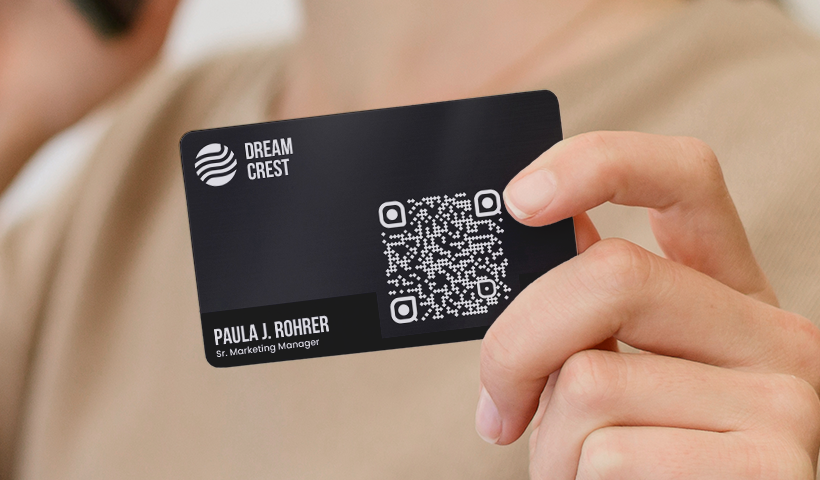
QR code business cards are popular because they are easy to use, affordable, and highly compatible.
If a phone has a camera, it can usually scan a QR code. No extra hardware, batteries, or apps are required in most cases. That makes QR codes ideal for broad visibility, whether on event badges, presentation slides, email signatures, packaging, or trade show booths.
One QR code can be shared with several people at once, making it especially useful for group networking.
The tradeoff is that the recipient must actively scan it.
NFC: The premium handshake
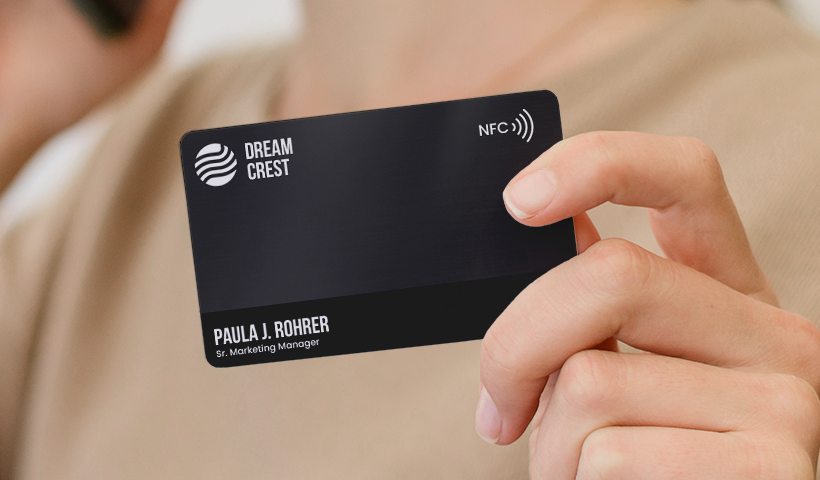
NFC business cards use the same basic technology behind contactless payments.
Instead of scanning, the recipient taps their phone to your NFC-enabled card, and your digital profile opens automatically. The interaction feels quick, polished, and modern, which is why NFC cards are popular with executives, consultants, sales professionals, and premium brands.
For one-to-one introductions, that smooth tap can create a stronger first impression than asking someone to scan a code.
The limitations, however, are physical. You have to carry the card. Furthermore, while nearly 90% of modern phones support NFC, older models or specific settings can sometimes cause a tap to fail, which can be a bit of a conversation killer if you don’t have a backup plan.
The real winner is your digital business card platform
Most comparisons stop at NFC vs. QR, which misses the bigger point.
Whether someone scans a QR code or taps an NFC card, they should arrive at a professional digital business card page that makes the next step effortless. They should be able to save your contact, call you, email you, visit your website, book a meeting, or follow your social channels within seconds.
Without a strong digital profile, NFC and QR codes are just delivery tools.
NFC vs QR Code Business Cards: At a Glance
| Feature | QR Code Card | NFC Card |
| Compatibility | Excellent | Very good |
| Sharing speed | Fast | Instant |
| Sharing distance | Can scan from a short distance | Requires close contact |
| Group sharing | Excellent | Limited |
| One-to-one impact | Good | Excellent |
| Requires a physical card | No | Yes |
| Best for virtual use | Excellent | Limited |
| Premium feel | Moderate | High |
| Works best with digital business cards | Yes | Yes |
| Customization | Digital-only; update anytime | Physical card design + digital profile |
Why the smartest professionals use both
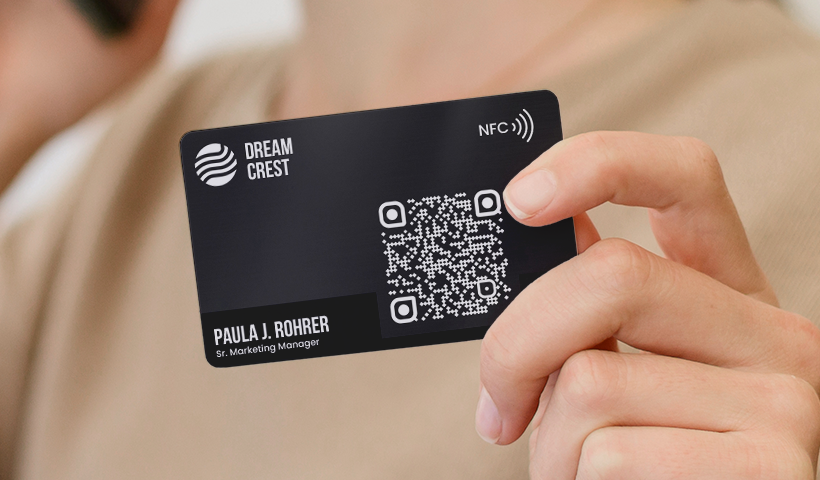
Top networkers rarely choose one format exclusively. They use each where it performs best.
As of March 2026, QR codes hold about 54% of the market share, with NFC trailing at 38%. But these numbers don’t tell the whole story. It’s not about which technology is better. It’s about which one fits the specific moment of connection.
QR codes are ideal for reach, remote sharing, and group settings. NFC cards shine during in-person introductions where speed and impression matter. When both point to the same digital business card profile, you get flexibility, reliability, and consistency across every touchpoint.
Why digitalbusinesscard.pro matters
Digital Business Card PRO is a digital identity platform built to help professionals present a consistent, up-to-date profile across every interaction.
Your QR code and NFC card are simply access points to a single, unified professional profile you control and can update anytime. No outdated details, no reprinting costs; just faster follow-ups, stronger first impressions, and more value extracted from every conversation.
Final verdict
If you want reach, choose QR.
If you want a premium presence, choose NFC.
If you want actual results, use both with a strong digital business card behind them.
The real NFC vs QR code question is not which technology wins, but which helps people connect with you faster. Today, technology is no longer the main thing. Your digital business card is.
Frequently Asked Questions
Should I choose NFC or QR code for my business card?
Choose QR Code if you need wider reach, remote sharing, or group visibility. Choose NFC if you want a smoother one-to-one introduction. For best results, use both.
Why do NFC business cards feel more premium than QR cards?
NFC cards create a tap-to-share experience that feels faster and more polished than asking someone to scan a code, especially in face-to-face networking.
Are QR code business cards still useful if NFC exists?
Yes. QR codes work almost everywhere a camera is available and can be shared on screens, badges, email signatures, packaging, and presentation slides.
What happens if someone’s phone does not support NFC?
That is why having a QR code backup matters. NFC can fail on older phones or due to phone settings, but a QR code gives people another way to access your profile.
Do NFC and QR cards need different digital profiles?
No. Ideally, both should lead to the same digital business card profile, so your contact details, links, booking options, and social channels stay consistent.
Which is better for conferences and trade shows?
QR codes are better for high-volume sharing because multiple people can scan from a short distance. NFC is better for direct conversations where the personal interaction matters more.
You may also like
Professional Email Signature Guide: What to Include and How to Create One
This guide discusses what a professional email signature is, what to include in it, how to create one, and how to use it with your digital card.
How Much Does a Digital Business Card Cost? (2026 Pricing Guide)
This guide helps you understand how much a digital business card costs and how much to invest based on your requirements.
How to Build a Personal Brand at Work Without Sounding Like Everyone Else
Learn how to build a personal brand at work using tactics that work inside a team: 1:1s, credit-sharing, and internal visibility.
Essential Tools for Field Sales Reps: What to Look for Before Choosing One
A practical framework for evaluating essential tools for field sales reps and the mistakes that break rep consistency in the field.