A booth conversation can become a sales opportunity. A hallway introduction can become a partnership. A five-minute exchange at a networking event can become a qualified lead.
Conferences create these moments constantly, and the data backs it up. Event-sourced leads convert to qualified opportunities at roughly 40%, compared to the 4.82% average across other B2B marketing channels. The problem is what happens next.
Most teams lose momentum right after the conversation ends. Contact details get scattered across business cards, badge scans, spreadsheets, and inboxes. Follow-ups happen late, ownership is unclear, and context disappears before high-intent opportunities ever reach the pipeline.
That is why conference networking cannot be left to individual habit. For sales, marketing, and leadership teams, it needs to be a structured workflow, not a personal skill each rep figures out alone.
This guide covers practical conference networking tips for teams, explains how to network at a conference as an organization rather than an individual, and breaks down the conference networking tools that help capture conversations, assign follow-ups, and measure event-driven pipeline.
Key Takeaways:
- Conference networking works best as a team workflow.
- Event conversations need clear capture and follow-up.
- Qualified leads matter more than contact volume.
- Digital business cards simplify and facilitate conference lead capture.
- Teams should measure event impact by pipeline, not scans.
- What is conference networking?
- Why conference networking breaks down for teams
- How to network at a conference as a team
- Conference networking checklist for teams
- Tips for networking events that help teams build pipeline
- The perfect digital business card setup for conference leads
- A simple conference networking workflow for teams
- How DigitalBusinessCard.Pro helps teams network better at conferences
- Common conference networking mistakes teams should avoid
- Conclusion: Turn conference conversations into measurable pipeline
- Frequently asked questions
What is conference networking?

Conference networking is the process of meeting people, starting relevant conversations, exchanging contact information, and continuing those conversations after the event ends. It happens across booths, sessions, workshops, private meetings, dinners, and informal networking spaces.
The stakes are higher than they look.
81% of trade show attendees have buying authority for the products and services they came to see, and 92% say they are actively looking for something new to buy. The goal is not just collecting contacts. It is building connections that turn into sales opportunities, partnerships, referrals, or long-term relationships.
For an individual, conference networking is about making good connections. For a team, it has to go further: a repeatable system that routes opportunities to the right person and moves qualified contacts into the pipeline.
Why conference networking breaks down for teams
Most teams show up to a conference with clear intentions: meet prospects, build relationships, and generate pipeline. The process breaks down anyway, because event conversations get handled in a fragmented way.
One rep saves contacts in their phone. Another keeps notes in a spreadsheet. Someone collects a stack of business cards. A handful of leads make it into the CRM; most stay buried in personal inboxes and scattered post-event notes, creating real problems:
- Follow-ups happen too late
- Sales and marketing lose shared visibility into the event
- Leads get qualified inconsistently, if at all
- Nobody can say which team members or booths produced the strongest opportunities
Conference success becomes almost impossible to measure this way. Your team knows how many people they met. They rarely know how many real opportunities came out of it.
The cost of that gap is real. Leads followed up within 24 to 48 hours are roughly 60% more likely to convert, yet only about 18% of event leads ever get a serious follow-up at all.
Every valuable conversation should be captured, assigned, followed up, and connected to the pipeline. That is the business case for a better conference networking workflow, and it is the problem DigitalBusinessCard.Pro was built to solve.
How to network at a conference as a team

Successful conference networking starts before anyone walks through the venue doors. Define what success looks like: sales leads, target accounts, partner relationships, or brand awareness. A shared goal keeps every team member focused on the right conversations instead of the nearest one.
From there, treat every conversation as part of one larger workflow:
- Set the goal
- Define the audience
- Assign the roles
- Align the message
- Decide the follow-up process
All of it, before the event even begins.
1. Before the conference: Prepare your team for better conversations
Preparation is what helps every team member focus on the right people and capture leads consistently instead of improvising on the spot.
1.1. Define the goal: Start by defining what your team actually wants: lead generation, partner meetings, customer expansion, or market research. A sales-led event calls for qualified prospects and demos; a leadership event calls for partnerships or strategic accounts.
1.2. Prepare your target list: Do not rely on walk-ins and random conversations. Review the attendee list, speaker lineup, and exhibitors before the event, and identify the accounts, customers, and industry leaders your team should meet. The payoff is measurable. Exhibitors who run pre-show outreach generate 46% more booth visits than those relying on walk-up traffic alone.
1.3. Standardize team profiles and contact sharing: Every team member needs updated, branded contact information before the event starts, including:
- Name, role, and company details
- Profile photo
- Contact links and calendar link
- Website and relevant resources
Consistent team profiles make your organization look more professional and easier to remember. This is where centralized business card management pays off: lock the template once, and every employee represents the same company.
1.4. Prepare lead capture fields: Decide in advance what information your team needs to collect, such as name, company, role, email, interest level, notes, and follow-up owner, so leads get qualified consistently instead of ending up as vague notes like “met at booth.”
1.5. Connect event leads to CRM or sales follow-up: Decide in advance how leads enter the CRM, who owns each follow-up, and what happens next, so conversations do not go cold while everyone decides who owns what. The incentive to move fast is significant: between 35% and 50% of B2B sales go to whichever vendor responds to the lead first.
2. During the conference: Turn conversations into captured leads
Once the event starts, your team’s focus should be simple: have the right conversations, and capture them while interest is fresh.
Tie each conversation to the person’s role, company, session, or business challenge, then ask qualifying questions early while keeping it natural:
- What brought you to the event?
- What problem are you trying to solve?
- Are you exploring solutions now or later?
- Who else is involved in the decision?
Contact sharing should be effortless. QR codes and digital business cards let your team share their details instantly and give prospects a simple way to save contact information, book a meeting, or submit their own details on the spot.
Lead capture is the step that matters most. Collect lead information during the conversation or immediately after, since details that felt obvious an hour ago are easy to forget by evening. Add context while it’s fresh, with notes like “interested in enterprise plan” or “met after keynote session,” and make sure every conversation ends with a clear action.
3. After the conference: Turn conversations into revenue
The real test of conference networking happens once everyone is back at their desks. Momentum fades fast, so what your team does in the days right after matters as much as the conversations themselves.
3.1. Segment and prioritize leads: Not every contact deserves equal attention. Sort captured leads by intent, account fit, and relationship stage so your team acts on the highest-value conversations first.
3.2. Assign follow-up owners: Every qualified lead needs one clear owner, whether that’s a sales rep, an account manager, or someone on the partnerships team. Leads without an owner are the ones that quietly go cold.
3.3. Personalize outreach based on the conversation: Generic post-event emails get ignored. Reference what was actually discussed: the challenge the person raised, the resource they asked for, or the demo they requested. That context turns a follow-up into a continuation of the conversation, not a form letter.
3.4. Move leads into the CRM and measure results: Qualified leads should move into the CRM as quickly as possible, tied to the event or team member that sourced them. From there, track meetings booked, demos scheduled, and opportunities created, so your team can see which parts of the event actually built pipeline.
Conference networking checklist for teams
Use this checklist to keep your team aligned before, during, and after the event.
Before the event
- Define the main event goal
- Identify target accounts, prospects, and industry contacts
- Assign team roles for booth conversations, meetings, and demos
- Update employee profiles with current details, links, and meeting options
- Prepare QR codes and digital business cards for contact sharing
- Set up lead capture forms with the right fields
- Align CRM fields, lead ownership, and follow-up workflows
During the event
- Start relevant conversations based on the person’s role, company, or interest
- Capture leads during or immediately after each conversation
- Add notes while the conversation is still fresh
- Tag leads by event, interest level, urgency, or team member
- Share booking links or relevant resources
- Review activity daily to see what’s creating the strongest opportunities
After the event
- Segment leads by priority, intent, or relationship stage
- Assign follow-up owners for every qualified contact
- Send personalized outreach based on the actual conversation
- Move qualified leads into the CRM
- Track meetings booked and opportunities created
- Measure event-sourced pipeline
Tips for networking events that help teams build pipeline

The best tips for networking events go beyond starting conversations. For a team, the real goal is turning the right conversations into qualified opportunities.
Focus on quality conversations, not contact volume
A smaller number of qualified conversations beats hundreds of vague badge scans every time, and most exhibitors agree.
93% say lead quality, not lead volume, is the outcome that actually matters from an event. Push your team toward relevance: who has a real need, who matches your target customer profile, and who is actually ready for a follow-up conversation?
Make your team easy to remember
Conference attendees meet dozens of people in a short window. Consistent digital profiles and clear branding help a prospect connect the conversation back to your company days later.
Capture context, not just contact details
A name and email address are useful, but not enough on their own. Capture notes on the person’s challenge, product interest, timeline, and preferred next step.
Follow up based on intent
Not every contact deserves the same follow-up. A high-intent lead needs a demo invitation. A partner conversation needs an introduction to the partnerships team. A casual connection is better suited to a light nurture email.
Review performance while the event is still active
Do not wait until the conference ends to see what’s working. Review which conversations, team members, or booth activities are generating the strongest interest, and adjust while there is still time to act.
The perfect digital business card setup for conference leads
Most of what teams reach for at a conference isn’t a separate tool at all. It’s one digital business card, built with the right pieces layered on top of it: a way to share it instantly, a way to capture the lead, a way to route it, and a way to measure it afterward.
The card itself
The card is the foundation. Instead of a paper card that gets lost in a bag, your team shares a branded profile via a QR code, link, NFC card, or wallet pass, complete with contact details, links, and built-in lead capture.
Instant sharing
A QR code on a badge, brochure, banner, or booth display lets a prospect scan once and land on the card, a product page, a demo form, or a meeting link, without typing a URL or searching for your company afterward.
Structured lead capture
Instead of loose details scrawled on the back of a card, the same fields get captured every time: name, company, role, email, interest level, notes, and preferred follow-up, whether it’s your first booth conversation of the day or your fiftieth.
Same-day CRM routing
A captured lead routes straight to Salesforce, HubSpot, Zoho, or whatever workflow your team already uses, instead of waiting for a manual spreadsheet upload days after the show.
One-tap meeting booking
A calendar link lets an interested prospect book a meeting, demo, or follow-up call on the spot while the conversation is still top of mind, rather than a vague “let’s set something up” that never happens.
Performance analytics
Scans, profile visits, lead submissions, and meeting bookings are all tracked, showing which team members, booths, or conferences generated the strongest opportunities rather than leaving it to gut feeling.
DigitalBusinessCard.Pro builds this entire setup into one card and one platform: sharing, lead capture, CRM routing, and analytics, all in place from the first scan, instead of stitching together five separate conference networking tools.
A simple conference networking workflow for teams
A strong conference networking process does not need to be complicated: prepare before the event, capture conversations during it, and move qualified opportunities forward after.
1. Prepare
Define target accounts, prospects, customers, team roles, digital profiles, messaging, and lead capture fields before the conference begins. The more of this is settled in advance, the less your team has to figure out on the fly once the show floor opens.
2. Engage
Start relevant conversations with the right people, asking questions that reveal their role, challenge, and next-step potential. The goal isn’t to talk to everyone who walks by; it’s to spend real time with the people who actually match your target account list.
3. Capture
Collect lead details while the conversation is still fresh: contact information, interest level, notes, and event context. Doing this in the moment, rather than reconstructing it from memory that evening, is what keeps the details accurate enough to act on.
4. Route
Send each lead to the right person: a sales opportunity to a rep, a partner conversation to the partnerships team, moving into the CRM as quickly as possible. A lead that sits unrouted for a few days is a lead that’s already cooling off by the time anyone reaches out.
5. Follow up
Reference what was discussed, send the right resource, or share a meeting link when the contact is ready to move forward. A follow-up that mentions the actual conversation reads as a continuation of it, not a cold outreach message that happens to know your name.
6. Measure
Review which employees captured qualified leads and which events actually created pipeline. This is what turns one good conference into a repeatable playbook, since your team can double down on the booths, sessions, and reps that worked and skip the ones that didn’t.
How DigitalBusinessCard.Pro helps teams network better at conferences
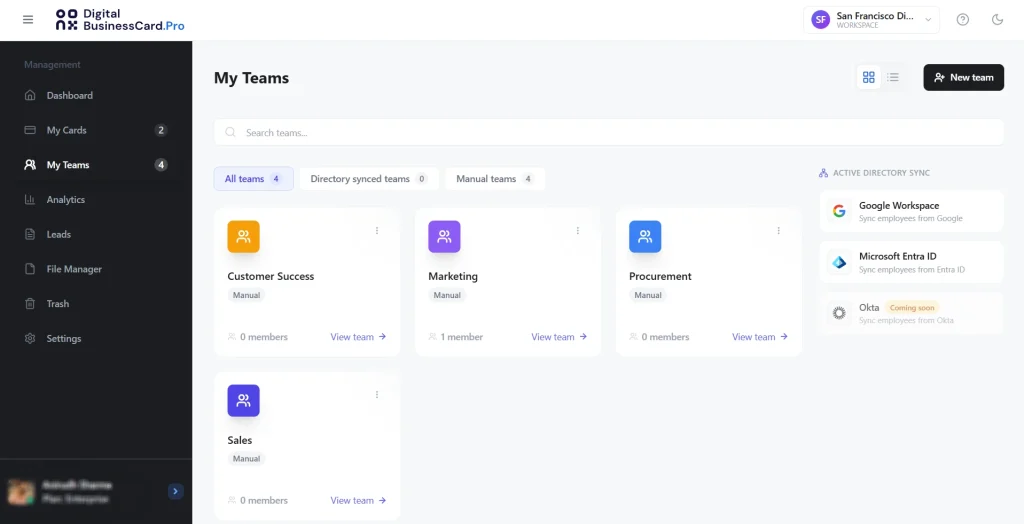
DigitalBusinessCard.Pro allows you to do more than just create digital cards. It’s built to solve what actually breaks when a whole team represents your company at an event, mapped feature to benefit:
- Locked templates and brand control solve the “make your team easy to remember” problem directly, keeping every employee’s card on-brand even when ten different reps are handing it out at ten different booths.
- Custom domain white labeling reinforces that same consistency at the exact moment it matters most, so a card on your own domain reads as your company, not a third party, right when a prospect decides whether to trust the link they just scanned.
- Bulk creation and directory integration solve the “standardize team profiles before the event starts” step on the preparation checklist, so a directory sync or CSV upload ensures every attending employee gets a current, branded card instead of someone updating profiles by hand the week before the show.
- Built-in lead capture fixes the exact gap this guide flags earlier, letting a prospect submit their own details on the spot so the conversation is captured while it’s fresh rather than reconstructed from memory that evening.
- CRM integration with Salesforce, HubSpot, or Zoho is what makes the “respond first” advantage possible, routing leads into the pipeline the same day rather than waiting for a manual spreadsheet upload after the moment has already passed.
- Advanced analytics with time-based and location views answer the question this guide keeps raising, turning “review performance while the event is still active” from a nice idea into something your team can actually do.
Put together, that’s the difference between a team that shows up to a conference with a stack of business cards and one that leaves with tracked, qualified, CRM-ready pipeline.
Common conference networking mistakes teams should avoid
Even strong teams lose valuable event opportunities when their conference networking process is unclear. Avoid these common mistakes:
- Attending without a clear goal: if nobody has defined what success looks like, every conversation feels equally important, and your team ends up spreading its energy across booth traffic instead of the accounts that actually matter.
- Letting every team member use a different pitch: when one rep talks features, another talks price, and a third talks something else entirely, prospects walk away with a fragmented impression of your company instead of a consistent one.
- Collecting contacts without qualifying them: a stack of badge scans or business cards feels productive in the moment, but a long contact list does not automatically mean strong pipeline if nobody knows who actually has a real need or budget.
- Depending only on paper business cards: they get lost in a bag, left in a hotel room, or thrown out by accident, and there is no way to track whether anyone ever followed up on them.
- Waiting too long to follow up: interest fades within days, sometimes hours, and a prospect who was genuinely engaged at the booth can forget the conversation entirely by the time a follow-up email finally arrives.
- Sending generic post-event emails: a templated “great meeting you” message signals that the conversation didn’t register. Reference the actual challenge, question, or product interest the person raised instead.
- Not assigning lead ownership or tracking event source: every qualified lead needs one clear owner and a tag showing which event, booth, or team member sourced it, or it will sit unclaimed while everyone assumes someone else is handling it.
- Measuring success by contact volume instead of team-level analytics: counting how many badges got scanned tells you nothing about which conversations turned into meetings, demos, or closed revenue. Track qualified leads and pipeline instead.
- Skipping a debrief after the event: without a quick review of what worked, your team repeats the same booth staffing, messaging, and follow-up mistakes at the next conference instead of improving on them.
Conclusion: Turn conference conversations into measurable pipeline
Good conference networking is not about meeting more people. It is about building a system that helps your team prepare better, capture the right conversations, and measure the business impact of every event. That impact is exactly what most B2B marketers are counting on.
Teams that win at conference networking do not leave follow-up to chance. They define their goals before the event, capture conversations while interest is fresh, and connect each interaction to the sales process.
With the right workflow and tools, every conference becomes a measurable source of pipeline, not a stack of business cards nobody follows up on.
Frequently asked questions
What are the best conference networking tips for teams?
Define event goals early, identify target accounts, assign team roles, prepare consistent messaging, use digital business cards or QR codes for contact sharing, capture lead context during conversations, and follow up quickly.
How do you network at a conference if you are attending as a sales team?
Identify target prospects and high-value companies before the event, then ask qualifying questions and capture lead details during it. Afterward, every qualified lead should be assigned to an owner and moved into the CRM.
What tools help with conference networking?
Useful conference networking tools include digital business cards, QR codes, lead capture forms, CRM integrations, calendar booking links, and analytics dashboards.
How can teams capture leads at conferences?
Teams can capture leads using digital business cards, QR codes, lead capture forms, or badge scans, alongside company name, role, interest level, notes, and event source.
How soon should you follow up after a conference?
Follow up as soon as possible, ideally within a few days of the conversation. Leads contacted within 24 to 48 hours convert roughly 60% more often than those left to sit, so high-intent leads should be contacted even faster.
How do digital business cards help with conference networking?
Digital business cards help teams share professional contact details instantly, capture leads from every employee profile, and keep branding consistent across event teams. Prospects can scan a QR code or open a link to save details, visit resources, or book meetings.
How do you measure conference networking success?
Conference networking success is measured by qualified leads, meetings booked, demos scheduled, opportunities created, pipeline influenced, and event-sourced revenue.
What should you do before attending a networking event?
Define your goal, research attendees and companies, prepare your target list, update team profiles, align your messaging, set up lead capture forms, and prepare QR codes or digital business cards.
You may also like
Professional Email Signature Guide: What to Include and How to Create One
This guide discusses what a professional email signature is, what to include in it, how to create one, and how to use it with your digital card.
5 Best Event Lead Capture Tools in 2026
Event lead capture gets messy fast. Let’s look at the five best event lead capture tools, and how to choose the right one.
6 Best Digital Business Card Platforms for Teams in 2026
Compare the 6 best digital business card platforms for teams and find the right platform for your organization.
How Much Does a Digital Business Card Cost? (2026 Pricing Guide)
This guide helps you understand how much a digital business card costs and how much to invest based on your requirements.