Somewhere in your office is a drawer of business cards from people who seemed genuinely interested but whom you never heard from again. That’s the real failure in offline lead generation: not the tactic, the follow-through.
Offline lead generation means winning prospects through channels outside digital ads and SEO: in-person events, direct mail, sponsorships, referral programs, and community partnerships.
It still works because it reaches people digital ads can’t: local audiences, high-trust referrals, and buyers who tune out online noise.
Below are 12 offline lead-generation ideas for businesses, grouped by type, along with the steps to run each. This piece is the tactical companion to our broader Offline Lead Generation Strategy guide, which covers the full approach: capture, qualify, and follow up.
Key Takeaways:
- Offline leads die without follow-up, not without good tactics.
- Run 2-3 offline channels together, not just one.
- House lists beat cold lists nearly 2x in direct mail response.
- Referral programs need an explicit ask, not just good service.
- Digital cards fix face-to-face capture; other tactics need their own tracking.
In-person & event-based
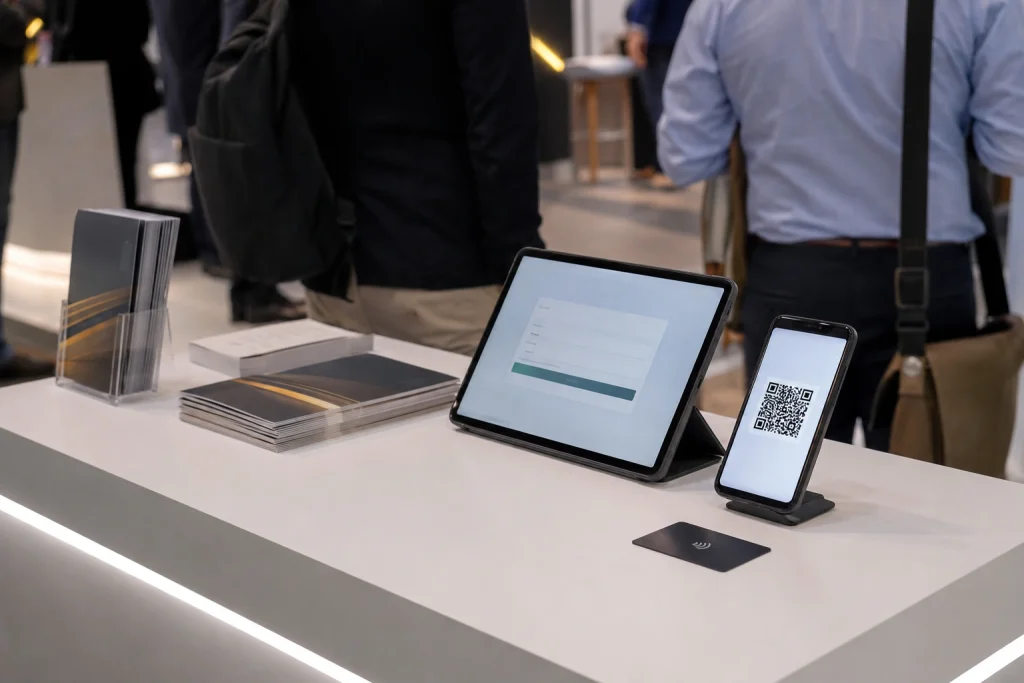
These tactics work because they put your business in front of buyers who are already paying attention, at a booth, a workshop, or a recurring networking group. The tradeoff is time: they rarely convert from a single appearance and depend on consistent, repeated presence.
1. Local trade shows and industry events
Book a booth or table at an event your buyers already attend. Bring a simple lead-capture method (not just a bowl for business cards), a one-line pitch, and a reason to give contact info (e.g., a raffle, a resource, or a demo).
A lead logged with context and followed up within a day or two converts at a completely different rate than one that sits in a stack of paper cards. That’s why many exhibitors now capture contacts with a digital business card instead.
Example: a local roofing company sponsors a home-and-garden expo booth.
Mistake: collecting cards but not logging who said what, so follow-up messages end up generic instead of relevant.
2. Workshops and lunch-and-learns
Host a free, genuinely useful session for your ideal customer, a topic they’d pay to learn, not a thinly veiled pitch. Keep the group small enough to talk with people individually (10 to 15 attendees works better than a lecture hall), and close with one clear, low-pressure next step instead of a sales ask.
Example: an accountant runs a “Tax Prep for Small Business Owners” lunch session.
Mistake: spending the session selling instead of teaching, which kills referrals and repeat attendance.
3. Chamber of commerce and networking groups
Join a local business group and show up consistently; one-off visits rarely convert. Most chapters have the same core group at every meeting, so needing three or four appearances before people remember your name is normal, not a sign the group isn’t working.
Example: a commercial insurance broker becomes a regular at monthly chamber mixers and picks up referrals over several months.
Mistake: treating the first meeting as a sales pitch instead of a relationship-building step.
Community & partnership
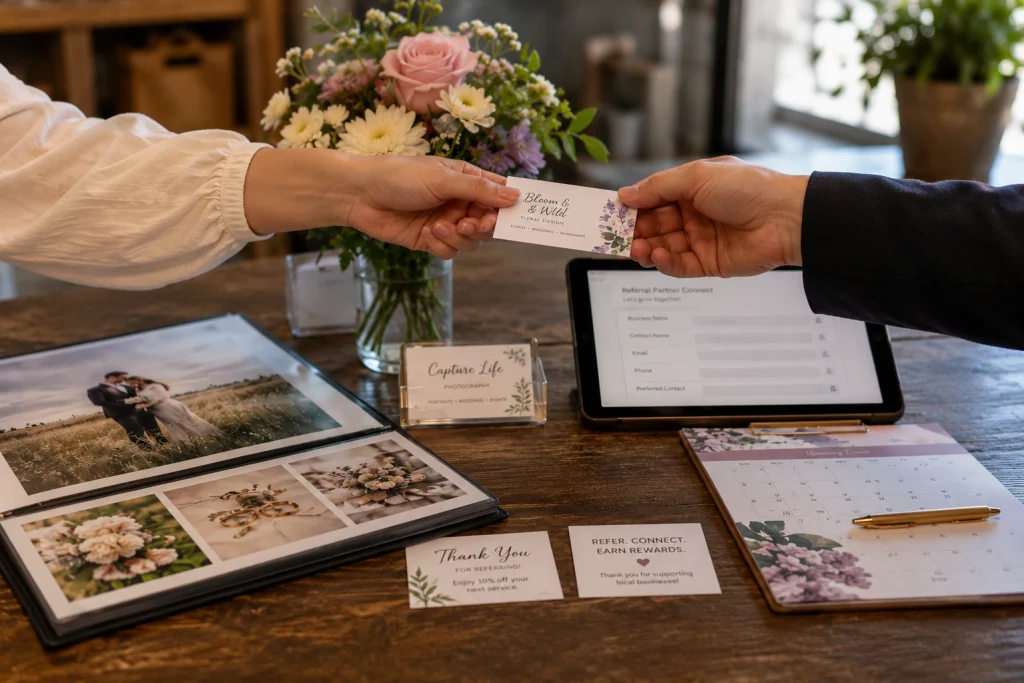
These ideas borrow trust you haven’t had to earn on your own: an existing audience, a local reputation, or genuine goodwill. They move slower than paid tactics, but the leads they produce tend to convert better because someone else has already vouched for you.
4. Co-marketing with complementary local businesses
Partner with a business that shares your audience but isn’t a competitor, and cross-promote to each other’s customers. Track referrals from the partnership separately so you can see whether the exchange stays balanced over a full quarter, not just the first event.
Example: a wedding photographer and a florist swap referrals and co-host a styled shoot.
Mistake: one-sided partnerships where only one business is actively referring.
5. Local sponsorships
Sponsor a youth sports team, community festival, or nonprofit event where your name gets seen repeatedly by a local audience. The value compounds with repetition: a jersey logo seen at ten games builds recognition in a way a single ad impression can’t.
Example: a dental practice sponsors a Little League team’s jerseys.
Mistake: sponsoring for visibility alone with no plan to capture leads from attendees.
6. Community involvement and volunteering
Show up at community drives, cleanups, or charity events as a business, not just a donor. Visible, repeated involvement is what separates this from a one-time donation; a single sponsored cleanup gets forgotten, a business that shows up every quarter becomes known for it.
Example: a real estate team volunteers at a local food bank and mentions it in follow-up emails and signage.
Mistake: treating this purely as PR instead of a genuine relationship-building channel.
Print & physical
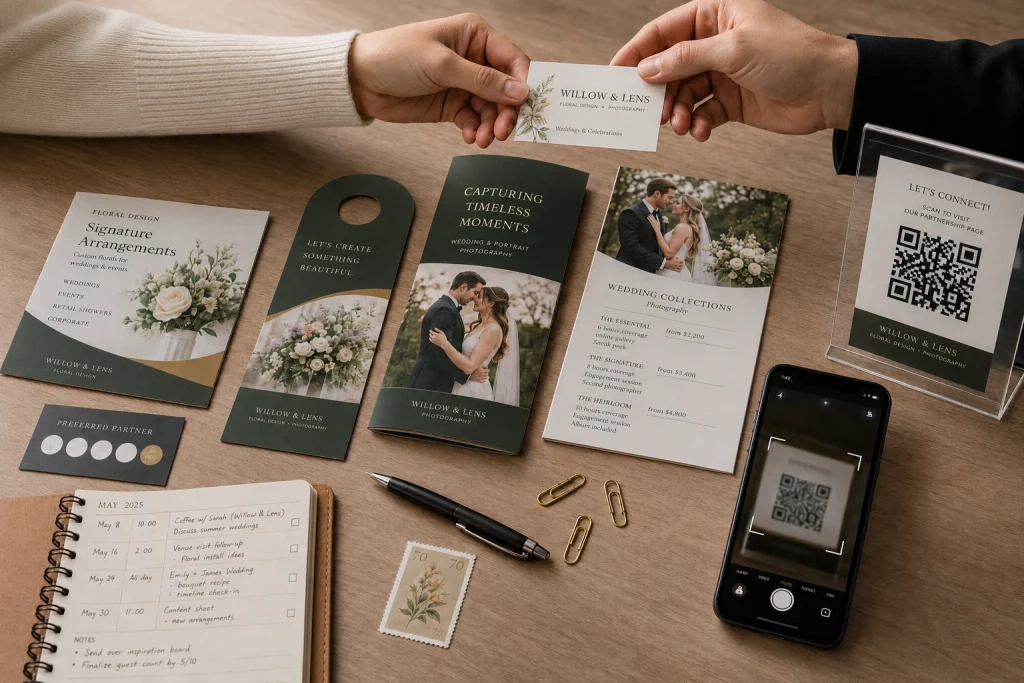
Physical materials still cut through in a way an inbox rarely does, but only when the offer and audience are tightly matched. A generic flyer or an unsegmented mailing list wastes the channel’s biggest advantage: actually getting seen.
7. Targeted direct mail
Send postcards or letters to a tightly defined local list; existing customers respond far better than cold prospect lists. Lob’s 2025 State of Direct Mail report found that 88% of marketers say personalized direct mail significantly improves response rates, and personalization is easiest to get right with a list of people who already know you.
Example: a landscaping company mails seasonal offers to homeowners within a five-mile radius.
Mistake: mailing a broad, untargeted list instead of a segmented one, which tanks response rates.
8. In-store signage and point-of-sale capture
Ask for contact info at the moment of highest interest (checkout, consultation, or service completion) with a clear reason: loyalty program, discount, or updates. Opt-in rates rise sharply when the ask is tied to something happening right then, like a raffle entry or an on-the-spot discount, rather than a generic “join our newsletter” sign.
Example: a boutique gym offers a free class in exchange for an email at sign-in.
Mistake: asking for info without explaining what the customer gets in return.
9. Flyers and door hangers
Distribute flyers within a defined local radius with a specific offer and a clear next step. A single, time-bound offer with a QR code or phone number outperforms a menu of every service, because it gives the reader one decision to make instead of five.
Example: a house-cleaning service leaves door hangers with a “first clean 20% off” offer.
Mistake: a flyer crammed with every service instead of one focused offer.
Relationship & referral
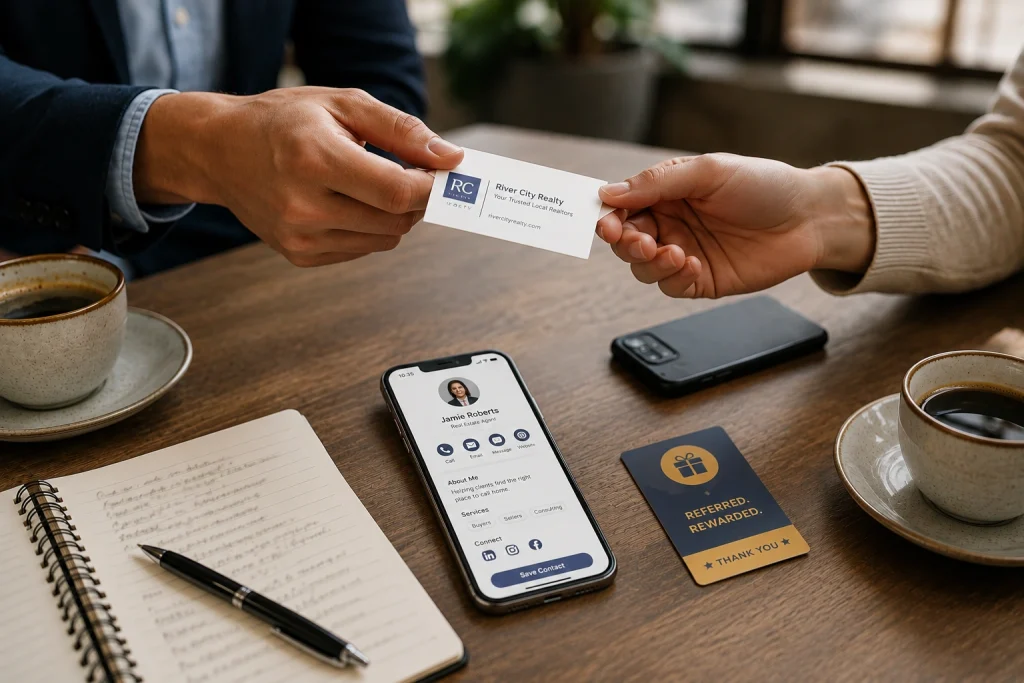
These ideas rely on people who already trust you, whether that’s a past customer, an audience at a talk, or a neighborhood you’ve already worked in. They cost less than most paid channels, but only pay off if you build the ask into the process instead of leaving it to chance.
10. Referral programs
Give existing customers a concrete reason to refer you to someone else: a discount, credit, or a small reward for both parties. People trust a recommendation from someone they know far more than any ad, and double-sided rewards (a benefit for both the referrer and the new customer) tend to outperform single-sided ones.
Example: an HVAC company gives $50 off to both referrer and new customer.
Mistake: relying on customers to refer without ever explicitly asking or incentivizing it.
11. Speaking engagements and panels
Offer to speak at local business events, podcasts, or association meetings on a topic where you have real expertise. An audience that shows up to hear you speak is pre-qualified: they chose the topic because it already matters to them, which is a warmer starting point than most outbound outreach.
Example: a financial advisor speaks at a small-business association on retirement planning.
Mistake: pitching from the stage instead of teaching; audiences remember who taught them something, not who sold to them.
12. In-person outreach and door-knocking
For local service businesses, direct outreach to a defined neighborhood or business district still works if it’s respectful and offer-led. Used near a recent, visible job, like a fresh roof or a new lawn, it doubles as social proof for the direct neighbors rather than a cold introduction.
A tap or scan of a digital business card at the door captures the lead on the spot, without the awkwardness of asking someone to write down their information.
Example: a solar installer canvasses a neighborhood after a nearby installation, using it as social proof.
Mistake: generic pitches lacking local relevance or proof points.
Convert Offline Leads Into Online Follow-Ups With DigitalBusinessCard.Pro
An offline lead that doesn’t enter a follow-up system within 24 hours is usually a lost lead.
For any tactic built around a face-to-face conversation (trade shows, workshops, chamber events, speaking engagements, in-person outreach), DigitalBusinessCard.Pro replaces the paper card when the lead is created and routes it directly into your follow-up system.
Key Benefits for Offline Lead Generation
- Instant capture, no app required: A contact scans a QR code or taps an NFC-enabled card and fills in a short lead form on the spot, so nothing depends on them remembering to follow up later.
- Direct routing to your contact list or CRM: Form submissions land where your sales process already lives, instead of sitting in a business card until someone has time to type it in.
- A built-in next step: A calendar-booking link can sit on the same card, so a warm lead can book a follow-up call before they walk away from the conversation.
- Consistent follow-up across a team: When multiple reps are working a booth or event together, everyone shares the same card template and lead form, so response quality doesn’t vary rep to rep.
- A record of what’s working: Because every scan is logged, you can see which events, reps, or locations are actually generating leads, rather than guessing after the fact.
The best offline lead-generation ideas still fail without a fast, consistent way to capture and follow up on the leads they produce. DigitalBusinessCard.Pro handles that last step, so a face-to-face conversation turns into a lead your team can actually work.
Conclusion
No single tactic on this list will carry an offline lead generation strategy alone.
Businesses that see real results usually run two or three at once: an event-based tactic, a referral or partnership angle, and one print or community channel, then measure which produces customers, not just contacts.
Start with one idea you can execute well this month, add a real follow-up process, and expand from there.
If you want to streamline offline lead generation, digital business cards are a must-have asset. With DigitalBusinessCard.Pro, your team can capture and manage leads in one place.
Frequently asked questions
What is offline lead generation?
Offline lead generation is generating prospective customers through non-digital channels: in-person events, print, sponsorships, referrals, and direct outreach, rather than online ads or search.
Is offline lead generation still effective in 2026?
Yes. Direct mail alone shows a 4.4% average response rate, compared with roughly 0.12% for email, as discussed earlier, and in-person channels benefit from lower competition for attention than crowded digital feeds.
How do you track offline leads?
Use a consistent capture method at the point of contact, such as a digital sign-up form, QR code, or lead-capture card, that feeds directly into a CRM or contact list, rather than relying on paper notes.
What’s the difference between offline and online lead generation?
Online lead generation relies on digital channels such as search, ads, and social media; offline lead generation relies on physical, in-person channels. Most effective lead generation strategies combine both, using offline tactics to start the relationship and online systems to nurture it.
Which offline lead generation idea works best for small businesses?
Referral programs and local sponsorships tend to have the lowest cost of entry and the highest trust factor for small, community-facing businesses.
You may also like
Professional Email Signature Guide: What to Include and How to Create One
This guide discusses what a professional email signature is, what to include in it, how to create one, and how to use it with your digital card.
How to Build a Personal Brand at Work Without Sounding Like Everyone Else
Learn how to build a personal brand at work using tactics that work inside a team: 1:1s, credit-sharing, and internal visibility.
Essential Tools for Field Sales Reps: What to Look for Before Choosing One
A practical framework for evaluating essential tools for field sales reps and the mistakes that break rep consistency in the field.
18 Business Networking Strategies for Professionals and Teams to Build Real Connections
Let’s look at the best business networking strategies for professionals and teams to build real connections.