Offline leads rarely disappear because the conversation went badly. They disappear afterward: contact details sit in a pocket, notes lose context, and follow-up starts after the prospect has already moved on.
Offline lead generation works best when every in-person interaction moves quickly through three steps: capture, qualify, and follow up.
This guide shows how to build that process across trade shows, retail counters, open houses, print campaigns, and networking events.
Key Takeaways:
- Manual capture is where most offline leads quietly get lost.
- Fast response time is the strongest predictor of conversion.
- Qualify leads on the spot; don’t treat every contact as hot.
- Digital business cards bridge offline capture to online CRM.
- Team consistency prevents leads from scattering across reps.
- What is offline lead generation?
- Does offline lead generation still work?
- The offline lead generation framework: Capture, Qualify, Follow Up
- Examples by channel
- Common mistakes in offline lead generation
- How DigitalBusinessCard.Pro helps
- Offline vs. online lead generation: How they work together
- Bringing it all together
- Frequently asked questions
- What is offline lead generation?
- Does offline lead generation still work?
- The offline lead generation framework: Capture, Qualify, Follow Up
- Examples by channel
- Common mistakes in offline lead generation
- How DigitalBusinessCard.Pro helps
- Offline vs. online lead generation: How they work together
- Bringing it all together
- Frequently asked questions
What is offline lead generation?
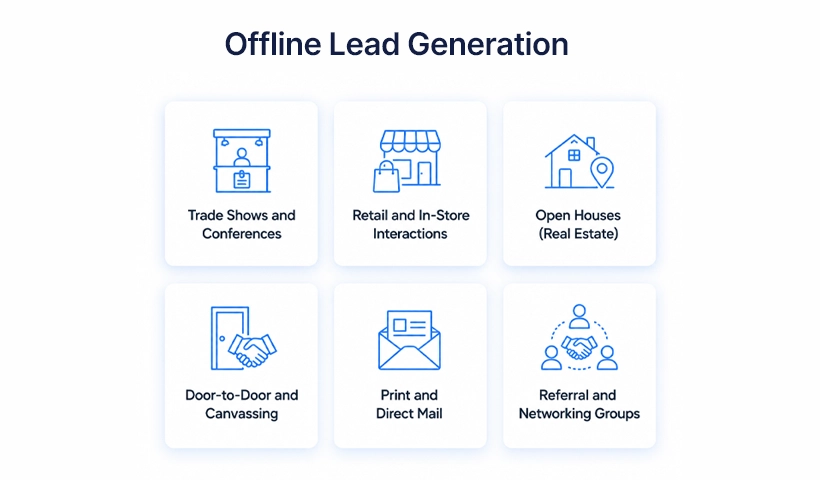
Offline lead generation means identifying and collecting prospect information through physical or in-person channels rather than through a website, digital advertisement, or online campaign.
It includes:
- Trade shows and conferences
- Retail and in-store interactions
- Open houses
- Door-to-door and canvassing efforts
- Print and direct mail campaigns
- Referral and networking groups, including chambers of commerce and industry associations
- Client visits, field sales, workshops, and local business events
The distinction from online lead generation is not that one is better than the other.
Offline leads begin with a physical or verbal exchange: a handshake, a booth conversation, a scanned badge, a business card, or a form completed at a counter. Digital tools may still be used to capture and manage the resulting lead.
That interaction has to become structured, usable data before a qualification or follow-up process can act on it. This conversion step is where offline lead generation often breaks down.
Does offline lead generation still work?
Yes. In-person interactions give representatives an opportunity to understand what prompted someone’s interest, hear their questions, clarify their requirements, and agree on a next step in real time.
The channel is not usually the problem. The challenge is what happens after the conversation.
When capture and follow-up are manual, slow, or disconnected, valuable context gets lost. A promising conversation may become an unreadable note, an unclaimed spreadsheet row, or a business card that never reaches the person responsible for following up.
A 2011 Harvard Business Review study of online sales inquiries found that companies contacting a lead within an hour were nearly seven times more likely to qualify it than companies that waited even an hour longer. The study examined online inquiries, not trade show or networking leads, but it supports a broader operational lesson: the longer a new inquiry waits, the harder it becomes to contact and qualify.
Offline lead generation performs better when contact details, qualification context, ownership, and the next step move into a consistent process before the conversation goes cold.
The offline lead generation framework: Capture, Qualify, Follow Up
A repeatable offline lead generation strategy comes down to three steps done consistently, not three separate tactics done occasionally.
1. Capture: Get the lead into a system, not a pocket
The most common failure mode in offline lead generation is not a lack of leads. It is what happens in the minutes after they are collected.
The manual capture problem
- A prospect hands over a physical business card, which gets stuffed into a jacket pocket.
- A representative jots down a name and phone number between conversations.
- Someone manually types a prospect’s email address while trying not to mishear it over the booth noise.
- Representatives enter prospect data into separate spreadsheets or paper forms.
- Badge exports remain unreviewed because no one owns the cleanup and import process.
Each step introduces delay and a chance of error: a misspelled name, a transposed digit, missing context, or a card that never reaches the sales team.
This is not a new problem. A 2015 Exhibitor Online survey, cited by Integrate, found that collecting business cards was still the most common lead-capture method among the surveyed exhibitors, ahead of badge scanners and handwritten forms. The data is dated, but it illustrates the operational weakness of collecting contacts without immediately turning them into usable records.
The gap is not about effort. It is about the method.
How a digital business card can help
Instead of handing over a paper card that must be entered later, a representative can share a digital business card through a QR code, NFC card, link, email signature, or messaging app.
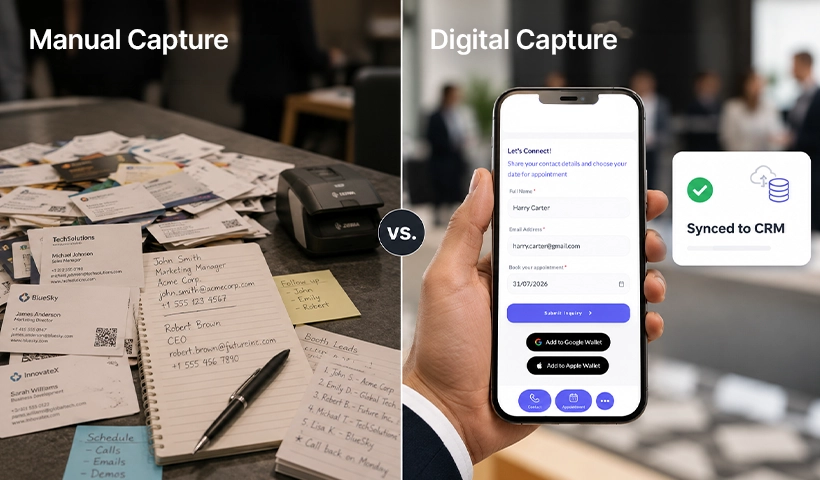
The recipient receives accurate, updated contact details without having to retain a physical card or manually search for the representative later.
The card can also invite the prospect to submit their own information through a lead capture form. The prospect must choose to complete and submit the form, but this reduces staff-side transcription and creates a structured lead record.
Captured leads can be stored in a centralized dashboard, exported, or synced with other tools depending on the available setup and integrations.
Capture only what you need
A long form can interrupt an otherwise natural conversation. Ask only for information your team genuinely needs to continue the discussion.
Depending on the channel, this may include:
- Name
- Work email or phone number
- Company and role
- Area of interest
- Buying timeline
- Preferred follow-up method
- Agreed next step
The purpose is not to complete an entire sales-discovery process at the point of capture. It is to collect enough accurate information to continue the conversation properly.
2. Qualify: Decide what a lead is worth while the context is fresh
Not every contact collected in person is a real opportunity.
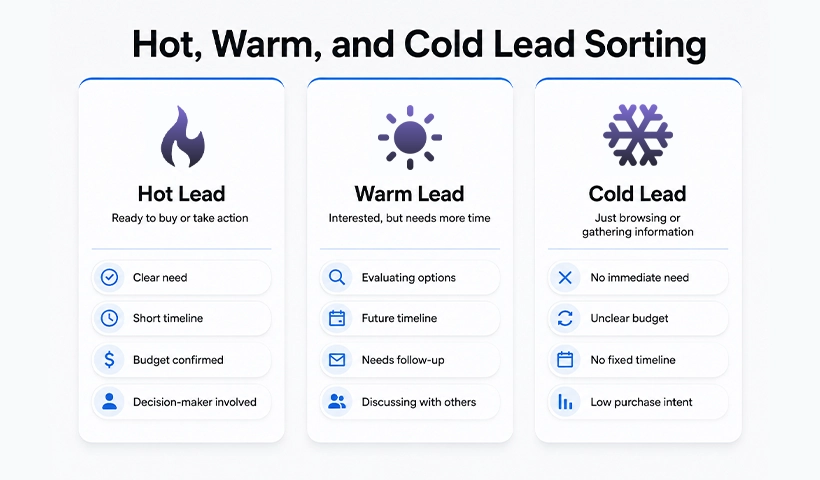
Some people exchange information for a giveaway, a raffle entry, or general curiosity. Others are actively evaluating a purchase, looking for a service provider, or trying to solve an immediate problem.
Treating all of them the same wastes the follow-up effort that should go to prospects who are ready to move forward. At the same time, deprioritizing the entire list because some contacts are unqualified can cause genuine opportunities to be overlooked.
A survey reported that 59% of exhibitors did not have a formal lead-ranking or scoring process. The figure should not be treated as a current industry benchmark, but it highlights a familiar problem: many teams collect contacts without recording enough information to prioritize them.
Qualification does not need to be elaborate. A few relevant questions asked during the conversation, and recorded alongside the contact, are usually enough to place the lead into a broad priority tier.
| Channel | Quick qualification questions |
| Trade show or conference | What problem are you trying to solve? Who else is involved in the decision? What is your timeline? |
| Open house | Are you pre-approved or still exploring? What is driving the move? Are you already working with an agent? |
| Retail or in-store | What brought you in today? What type of product are you looking for? Would you like relevant availability updates? |
| Referral or networking group | What is the specific need behind the introduction? Is there an active project or budget? What would be a useful next step? |
| Field sales or client visit | What are you currently using? What is not working? When would you want a new solution in place? |
The goal is not a perfect lead score. It is a practical indication of priority, such as hot, warm, or cold, attached to the contact while the conversation is still fresh.
A short note about what the prospect asked, what mattered to them, and what was promised is often more useful than a complicated score added days later.
3. Follow up: Close the loop before it goes cold
Speed matters, but speed alone is not enough. The follow-up also has to be relevant to the conversation.
The same 2015 Exhibitor Online survey reported that 38% of exhibitors took longer than six days to follow up with event leads. Again, the figure is dated, but the underlying risk remains valid: after several days and dozens of other conversations, both the representative and the prospect may struggle to remember what made the interaction relevant.
Follow-up timing should reflect the strength of the opportunity:
- Follow up the same day when the prospect requested information, agreed to a meeting, or has an immediate requirement.
- Contact warm leads within 24 hours, while the discussion is still fresh in their minds.
- Move lower-priority contacts into an appropriate nurture process within 48 hours instead of abandoning them.
- Follow any specific timeline agreed upon during the conversation.
A few practices make follow-up more effective:
- Reference the actual discussion. Mention the event, question, requirement, or promised resource instead of sending a generic template.
- Assign a clear owner. A lead with no named owner quietly stalls.
- Use the appropriate channel. Email may suit detailed resources, while a call, message, or LinkedIn connection may better match the original interaction.
- Record the expected next step. “Send product information,” “arrange a demo,” and “follow up next quarter” require different workflows.
- Keep the source attached. Record the event, location, representative, campaign, or printed asset that generated the lead.
Digital capture helps because the team does not have to wait for someone to sort cards or reconstruct conversations from memory. The contact can be reviewed, assigned, and followed up while the interaction is still relevant.
Examples by channel
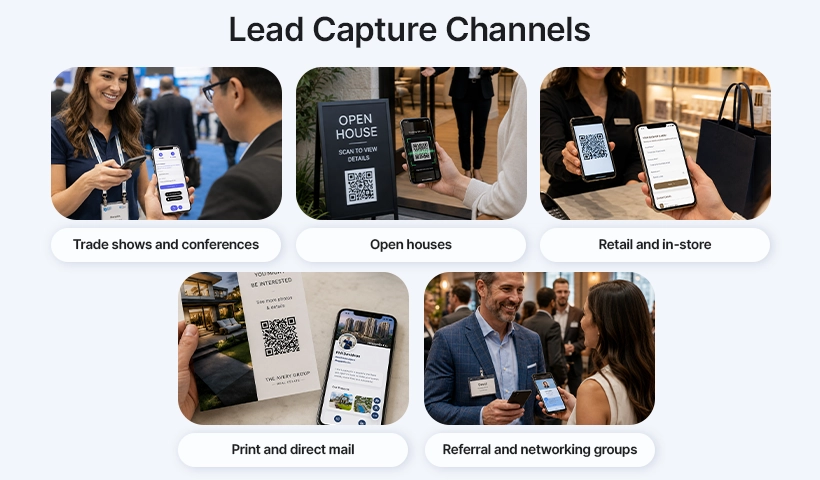
The same capture, qualify, and follow-up framework applies across offline channels, but the execution changes depending on where the interaction happens.
Trade shows and conferences
A booth representative can share a digital business card through a QR code or NFC card and invite the visitor to complete a short lead form.
The representative can then record the visitor’s product interest, role, timeline, and agreed next step while the conversation is still fresh. A hot lead may require same-day follow-up, while an early-stage contact may be better suited to a nurture sequence.
Open houses
A QR code at the entrance can replace an unreadable paper sign-in sheet with a short form that captures contact details and a few relevant questions about budget, timeline, location preferences, and financing status.
The agent can then follow up with suitable properties or arrange a viewing based on the visitor’s stated needs.
Retail and in-store interactions
A counter QR code, consultation form, or digital business card shared by an associate can turn a useful in-store conversation into a contact the business can follow up with.
The information requested should match the situation. Someone asking about product availability does not need to complete the same form as someone requesting a detailed consultation.
Print and direct mail
A QR code or short URL on a flyer, brochure, or postcard can direct the recipient to a campaign-specific landing page or form.
Because the link is associated with a particular campaign or printed asset, the business can preserve the lead source and route the response into the appropriate workflow.
Referral and networking groups
At a chamber meeting, industry meetup, or referral event, a digital card exchange can make it easier to continue the conversation without relying on a stack of paper cards.
The follow-up should mention the introducer, the original discussion, and the specific reason for connecting.
Field sales and client visits
A representative can share a digital card or mobile form during a site visit and record the client’s existing process, pain points, stakeholders, and expected timeline.
The contact can then be routed to the correct product specialist, territory owner, or account manager.
Common mistakes in offline lead generation
Most offline lead-generation failures trace back to a small number of recurring process problems.
Skipping qualification entirely
Treating every captured contact as a hot lead burns time on people who were never ready to buy, while genuinely interested prospects get lost in the noise.
A few qualification questions and a broad priority tier at the point of capture are usually enough to prevent this.
Letting follow-up slip
A delayed response makes it harder for both the prospect and the representative to remember the discussion.
This problem worsens when contacts must first be sorted, transcribed, or cleaned before anyone can act on them.
Relying on manual data entry
Misspelled names, incorrect phone numbers, unreadable handwriting, and missing notes can make a lead difficult or impossible to use.
Digital capture does not prevent every mistake, but it reduces the need for representatives to re-enter contact details later.
Leaving ownership unclear
At a multi-representative event or busy retail location, contacts may be collected through personal phones, paper forms, event systems, and separate spreadsheets.
Without a defined ownership rule, each person may assume someone else is following up.
Decide in advance whether the lead belongs to the representative, territory owner, account owner, product specialist, or central sales team.
Having no plan for leads that are not ready
“Not now” is not the same as “no.”
Warm or lower-priority contacts may still need occasional, relevant communication rather than aggressive sales outreach or complete abandonment.
Collecting information without clear consent
A contact exchange does not always provide permission for ongoing marketing.
Explain why the information is being collected, collect only what is necessary, and obtain marketing consent where required. Follow-up related to the prospect’s original request should also be distinguished from unrelated promotional communication.
How DigitalBusinessCard.Pro helps
Every mistake above comes down to a similar problem: the delay between when a contact is collected and when it becomes usable, structured information.
DigitalBusinessCard.Pro helps close that gap at the point of offline contact.
- Accurate contact sharing: Representatives can share current contact details through a QR code, NFC card, link, email signature, or messaging app.
- Lead capture forms on the card: Prospects can submit their details, interests, and intent without requiring the representative to transcribe the information later.
- Centralized lead management: Captured contacts can be stored and managed through an organized dashboard instead of remaining scattered across personal phones, notebooks, and spreadsheets.
- Import and export options: Teams can import existing contacts or export captured leads for use with other business tools.
- CRM connectivity: Captured leads can be synced with a CRM where the appropriate integration and setup are available.
- Team consistency: Shared templates, centrally managed employee information, and brand controls help representatives use a consistent lead-capture experience.
- Engagement analytics: Teams can review card views, leads, link clicks, contact saves, and activity over time to understand what happens after the exchange.
DigitalBusinessCard.Pro supports custom lead forms, a centralized leads dashboard, and contact import and export options.
For a solo professional working an open house, this may mean one consistent card and a short lead form. For a company attending a trade show, it may mean branded cards for every representative, centralized visibility, and a consistent process for routing opportunities to the right person.
Offline vs. online lead generation: How they work together
Offline and online lead generation are not competing strategies. They are different entry points into the same pipeline.
A prospect met at a trade show and a prospect who completed a website form should eventually enter a consistent qualification, ownership, and follow-up process.
Online leads arrive as structured data by default. Offline leads often begin as a conversation, business card, badge scan, handwritten note, or physical campaign response.
The objective is to preserve the context of the offline interaction while making the resulting information as usable as an online lead.
When both sources follow the same process, teams can compare lead quality, response time, meetings booked, opportunities created, and pipeline generated by each channel.
Bringing it all together
Offline lead generation does not fail simply because the channels are weak. Trade shows, open houses, retail counters, client visits, and referral introductions still create valuable business conversations.
The problem is often the last mile: cards that sit in a pocket, notes that never reach the sales system, qualification that happens too late, and follow-up with no clear owner.
Start with the framework, not the tools: capture cleanly, qualify while the context is fresh, and follow up according to the prospect’s intent.
Once that process is in place, digital tools can help teams carry the information from the original conversation into a structured workflow without losing the human context that made the lead valuable.
Frequently asked questions
What is offline lead generation?
Offline lead generation is the process of identifying and collecting prospect information through physical or in-person channels, such as trade shows, retail interactions, open houses, print materials, client visits, and networking events.
The interaction begins offline, even when digital tools are later used to capture and manage the resulting lead.
What’s the fastest way to capture leads at a trade show?
The best method depends on the event and the team’s workflow.
An event badge-scanning system may work well when it is connected to your lead-management process. A digital business card with an embedded form provides a flexible alternative when your team wants a capture method it controls.
Whichever method you choose, collect the prospect’s details, qualification context, source, and expected next step before the conversation is forgotten.
How quickly should you follow up with a lead you met in person?
Follow up the same day when the prospect requested information, agreed to a meeting, or has an immediate need.
Most warm leads should receive a relevant response within 24 hours. Lower-priority contacts should be placed into an appropriate nurture process instead of being left unreviewed for days or weeks.
What’s the difference between offline and online lead generation?
Offline lead generation begins through physical or in-person channels, while online lead generation begins through digital channels such as websites, advertisements, social media, and online forms.
Both should ultimately feed a consistent qualification, ownership, and follow-up process.
How do you qualify a lead you just met?
Ask a few relevant questions about the prospect’s problem, interest, timeline, decision-making role, and expected next step.
Record a broad priority tier and a short conversation note while the context is fresh. A useful note added immediately is usually more valuable than a detailed score applied days later.
Can a digital business card replace a lead capture form?
A digital business card can include a lead capture form directly on the card, so a separate paper form or sign-up sheet may not be necessary.
The card does not collect the prospect’s information simply because it has been scanned. The recipient must complete and submit the form. The captured information can then be managed through a centralized dashboard, exported, or synced with a CRM where the required setup is available.
You may also like
Professional Email Signature Guide: What to Include and How to Create One
This guide discusses what a professional email signature is, what to include in it, how to create one, and how to use it with your digital card.
5 Best Event Lead Capture Tools in 2026
Event lead capture gets messy fast. Let’s look at the five best event lead capture tools, and how to choose the right one.
How Much Does a Digital Business Card Cost? (2026 Pricing Guide)
This guide helps you understand how much a digital business card costs and how much to invest based on your requirements.
How to Integrate Digital Business Card with Your HubSpot
Learn how to connect HubSpot with Digital Business Card PRO, map form fields, and automatically send digital business card form submissions to HubSpot.