Brand consistency across teams means customers encounter the same recognizable identity, accurate information, and reliable experience regardless of which employee, department, location, or channel they interact with.
That becomes harder as organizations grow. A company may tightly control its website and campaigns while hundreds or thousands of employees represent the same brand through meetings, events, sales conversations, profiles, presentations, and contact sharing.
Brand consistency cannot scale through guidelines alone. It requires systems that standardize what matters, define ownership and permissions, keep information current, and connect customer-facing interactions to measurable results.
Key Takeaways:
- Brand consistency requires systems, not guidelines alone.
- Controlled flexibility keeps teams aligned without slowing them down.
- Centralized data prevents outdated employee information.
- Offline touchpoints should lead to measurable digital actions.
- Employee identity should be managed as a company-wide brand asset.
- What does brand consistency across teams really mean?
- Why brand consistency breaks as teams grow
- A six-step framework for brand consistency across teams
- How to connect offline brand touchpoints with measurable results
- Why employee identity should be a priority touchpoint
- Common brand consistency mistakes to avoid
- Brand consistency across teams checklist
- Make brand consistency systemic
- Frequently asked questions
What does brand consistency across teams really mean?
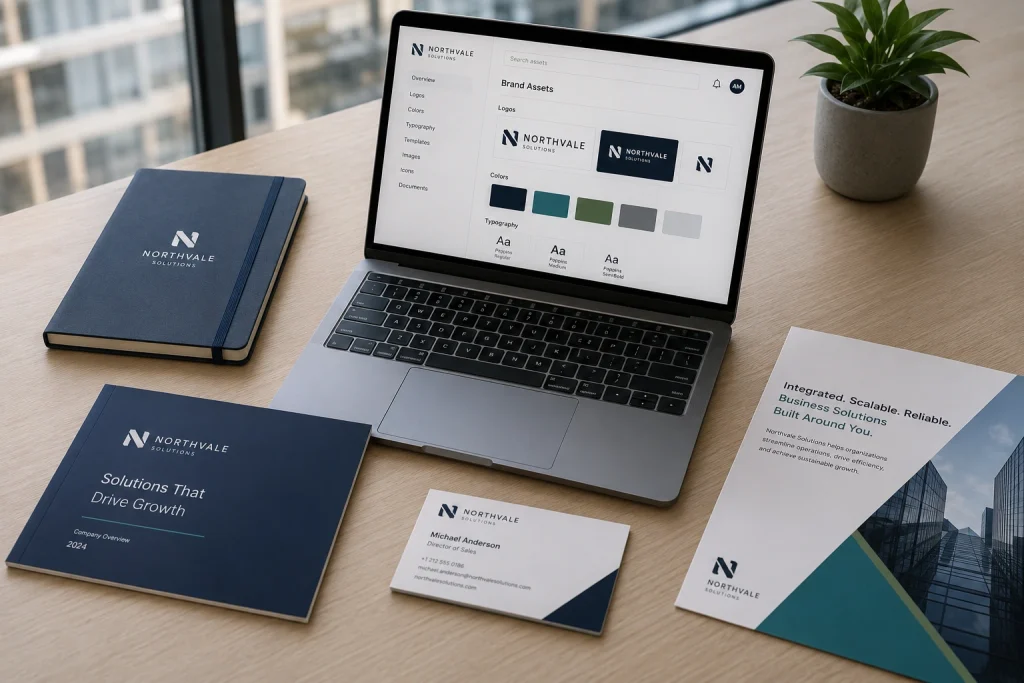
Brand consistency across teams is the practice of maintaining shared brand standards across employees, departments, locations, and customer-facing interactions.
Visual identity is part of it, but customers also experience your brand through employee profiles, sales materials, business cards, email signatures, event collateral, contact sharing, forms, follow-up, and regional marketing.
Consistency matters because customers rarely experience a company through one channel.
McKinsey’s 2024 Global B2B Pulse survey found that B2B decision-makers use an average of 10.2 channels during the buying journey. The same research found that 56% would abandon a purchase or switch suppliers after a poor-quality omnichannel customer experience.
Trust depends on reliability too. In PwC’s 2024 Trust Survey, 73% of consumers said delivering a consistent and reliable customer experience was very important to earning their trust.
Brand consistency is therefore not simply a design problem. It is an operational challenge involving people, systems, data, governance, and customer experience.
Brand consistency vs. brand governance
Brand consistency and brand governance are closely related, but they solve different parts of the problem.
Brand consistency is the customer-facing outcome.
Customers see the right identity, accurate information, recognizable messaging, and a dependable experience regardless of who represents the company.
Brand governance is the operating system that produces that consistency.
It defines:
- Standards
- Templates
- Ownership
- Permissions
- Data sources
- Approval rules
- Update processes
- Brand compliance
Measurement is the feedback loop. It shows whether standardized touchpoints are being used correctly and whether they contribute to meaningful customer actions and business results.
In simple terms:
Consistency = customer-facing outcome
Governance = operating system
Measurement = feedback loop
Consistency does not mean uniformity
A recruiter, salesperson, account manager, and executive should not communicate identically. Their roles and customer conversations are different.
The goal is controlled flexibility.
The organization controls what defines the brand, while employees retain control over information that legitimately belongs to them.
For example, the company may control:
- Logo
- Brand colors
- Company name
- Website
- Standard company description
- Approved calls to action
Employees may be allowed to update:
- Profile photo
- Phone number
- Professional bio
- Approved social links
- Calendar availability
The best systems make it difficult to change what should remain fixed while making legitimate updates easy.
Why brand consistency breaks as teams grow
Brand inconsistency rarely happens because employees deliberately ignore brand guidelines. It usually develops gradually as more people, systems, departments, and locations become involved.
Teams create their own versions
Marketing creates an approved presentation. One salesperson modifies it. Another keeps an old version locally. A regional team adapts the messaging.
Months later, several versions are still being used.
The same problem can affect business cards, proposals, email signatures, employee profiles, event materials, brochures, and social assets.
Each change may seem minor. Together, they create brand drift.
Employee information becomes outdated
Employees change roles, territories, offices, phone numbers, and responsibilities.
If customer-facing assets depend on manual updates, old information can remain active long after the source data has changed. At enterprise scale, asking every employee to maintain multiple profiles, cards, signatures, and related assets independently creates unnecessary risk.
Employee touchpoints sit outside marketing systems
Most organizations can closely control their websites, paid campaigns, social accounts, and email programs. Direct employee interactions are different.
A salesperson meets a prospect at a conference. A consultant shares contact details after a meeting. A recruiter connects with a candidate. An account manager visits a customer.
These interactions may influence real business outcomes, but marketing often has limited control or visibility.
That creates two gaps:
Governance gap: Was the company represented correctly?
Measurement gap: Did the interaction produce a meaningful customer action?
Distributed organizations multiply the problem
Remote teams, international offices, acquisitions, and separate business units increase the number of people representing the same organization.
A brand guide can tell employees what they should do. It cannot ensure they are using the right information, links, templates, or customer experience.
That requires a system.
Also read: How Enterprises Can Manage Hundreds of Digital Business Cards Across Multiple Teams
A six-step framework for brand consistency across teams
A scalable brand-consistency system should answer six questions:
- Where does the brand appear?
- What must stay consistent?
- What can employees personalize?
- Who controls each asset or field?
- How are updates distributed?
- How is performance measured?
Step 1: Map customer-facing touchpoints
Audit every place where employees, teams, locations, or business units represent the brand.
Cover both digital and physical touchpoints, including:
- Website
- Email signatures
- Employee profiles
- Sales decks and proposals
- Business cards
- Events and trade shows
- Brochures and signage
- Client meetings
- Regional or local materials
For each touchpoint, record ownership, edit access, central control, and measurability.
| Touchpoint | Primary owner | Centrally controlled? | Employee editable? | Measurable? |
|---|---|---|---|---|
| Corporate website | Marketing | Yes | No | Yes |
| Sales deck | Sales + Marketing | Partly | Partly | Limited |
| Employee business card | Admin/Employee | Varies | Often | Usually limited |
| Email signature | IT/Employee | Varies | Often | Limited |
| Event lead capture | Sales/Events | Varies | Yes | Often |
| Employee digital profile | Admin/Employee | Can be | Can be controlled | Yes |
This usually reveals the biggest governance gaps. Employee-led touchpoints are often high-volume but loosely controlled, making them a logical priority.
Step 2: Define what is non-negotiable
Decide which elements must remain consistent across every touchpoint.
These may include:
- Logo and brand colors
- Fonts
- Company name
- Approved descriptions
- Website domain
- Legal or compliance information
- Standard links and calls to action
Then define what employees may edit, such as their photo, phone number, bio, social links, or calendar availability.
Build these rules into the tools employees use. For example, Digital Business Card.Pro can keep brand-critical fields controlled while allowing approved employee-specific updates.
Protect what defines the organization. Make legitimate updates easy.
Step 3: Standardize with templates
Manual approvals do not scale.
Use approved templates for repeatable touchpoints such as digital business cards, employee profiles, physical visiting cards, presentations, proposals, email signatures, and event collateral.
Lock brand-critical elements and leave approved areas flexible.
The goal is to make compliance part of the workflow, rather than relying on employees to interpret the brand guide correctly every time.
Step 4: Create a single source of truth
Brand consistency also depends on accurate data.
An employee’s title, phone number, or role may appear across several systems. If each one stores its own version, outdated information is inevitable.
Define:
- Where employee data originates
- Who can edit it
- Which systems use it
- How updates are synchronized
- What happens during role changes and offboarding
For larger teams, integrations with Microsoft Entra ID or Google Workspace can reduce manual maintenance. Digital Business Card Pro also supports directory-based provisioning and bulk creation through CSV or Excel.
Every disconnected copy of the same information creates another place for the brand to become outdated.
Step 5: Assign ownership and permissions
Brand consistency spans multiple teams, so ownership must be explicit.
| Area | Primary owner |
|---|---|
| Brand identity and templates | Marketing |
| Employee identity data | HR |
| Authentication and access | IT |
| Customer-facing usage | Sales or relevant team |
| Measurement and attribution | Marketing/Revenue Operations |
| Regional exceptions | Regional owner + Brand team |
Permissions should follow those responsibilities.
Protect brand-critical information while giving the right people enough access to make legitimate updates quickly.
The goal is not maximum control. It is clear control.
Step 6: Measure business impact
Standardization shows whether the right experience was deployed. Measurement shows what happened next.
Track metrics across four levels:
Governance
- Template adoption
- Data accuracy
- Outdated assets
- Brand compliance
Engagement
- Profile visits
- Contact saves
- Link clicks
- Resource views
Intent
- Lead submissions
- Meeting bookings
- Information requests
Business outcomes
- Qualified leads
- Opportunities
- Pipeline
- Revenue
The goal is to move from:
“Was the asset used?”
to:
“Did the interaction create meaningful customer action?”
Use the cycle:
Standardize → Govern → Activate → Measure → Improve
Consistency is the customer-facing outcome. Governance creates it. Measurement shows whether it contributes to meaningful business results.
How to connect offline brand touchpoints with measurable results
Offline interactions are valuable but difficult to track.
Websites, ads, emails, and forms generate clear digital signals. Conferences, client meetings, networking events, and field visits often do not.
That gap matters. The Freeman 2024 Exhibitor Trends Report, based on 1,911 respondents, found that 93% rated the quality of expected attendees as extremely or very impactful when exhibiting at in-person events.
High-value offline interactions should therefore lead to a measurable digital next step.
Turn offline interactions into digital entry points
Connect physical touchpoints to trackable digital destinations.
For example:
- Digital business cards can open employee profiles.
- NFC cards can launch branded contact-sharing experiences.
- Printed materials can link to trackable pages.
- Event assets can connect to lead forms or booking pages.
- Employee profiles can support contact saves, content access, or meeting requests.
The offline interaction creates attention. The digital destination makes the next action measurable.
Connect interactions to business outcomes
Use a simple measurement chain:
Offline interaction → Digital touchpoint → Customer action → CRM or analytics → Business outcome
For example, a prospect meets a salesperson at an event, opens their digital business card, and books a meeting. That action can enter the sales workflow and later contribute to an opportunity, pipeline, or revenue.
This is more useful than reporting scans or profile views alone.
Track intent, not just activity
Measure interactions by value:
Awareness
- Profile visits
- Page views
- Content interactions
Engagement
- Contact saves
- Link clicks
- Resource downloads
Intent
- Lead submissions
- Meeting bookings
- Information requests
Business outcomes
- Qualified leads
- Opportunities
- Pipeline
- Revenue
A profile visit shows activity. A meeting request shows intent. An opportunity shows commercial value.
Prioritize metrics closest to a customer decision.
Measure at the right level
Aggregate numbers can hide what is actually working.
Instead of stopping at total visits or scans, compare performance by:
- Event
- Team
- Region
- Employee
- Touchpoint
Ask which interactions generate meetings, qualified leads, opportunities, or stronger follow-up.
This helps marketing improve assets, sales leaders identify effective behaviors, and event teams make better investment decisions.
The customer-experience impact matters too. PwC’s 2025 Customer Experience Survey, based on 5,511 U.S. consumers and 406 executives, found that 29% of consumers had stopped using or buying from a brand because of poor customer experience, while 70% of executives said customer expectations were evolving faster than their companies could adapt.
Connecting employee-led interactions to controlled digital experiences gives organizations clearer visibility into what works, where follow-up breaks down, and which offline touchpoints contribute to business results.
Why employee identity should be a priority touchpoint
Employee identity is one of the hardest brand touchpoints to control at scale.
Every employee represents the company through their name, title, contact details, profile, branding, and follow-up experience. When that information is managed manually, inconsistencies appear quickly.
Printed business cards make the problem obvious. A job title changes, a phone number is updated, or the company refreshes its branding, and existing cards immediately become outdated. Across large or distributed teams, those outdated versions can remain in circulation for months.
The better approach is to manage employee identity centrally while allowing controlled personalization.
With DigitalBusinessCard.Pro, organizations can:
- Standardize employee cards with approved templates and brand elements.
- Lock brand-critical fields so employees cannot change logos, company details, or other protected information.
- Allow controlled employee edits for fields such as phone numbers, profile photos, or bios.
- Update information centrally without reprinting or redistributing cards.
- Deploy cards at scale across teams, departments, and locations.
- Keep employee data current through centralized management and directory-based workflows.
- Measure engagement after cards are shared, including profile activity and follow-up actions.
- Support consistent offboarding and role changes by updating or removing access from one system.
This makes employee digital business cards more than a replacement for paper cards. They become part of the company’s brand-governance and employee identity infrastructure.
The action is straightforward: treat employee identity as a centrally managed brand asset, not an individual employee responsibility.
That gives the organization tighter control over brand consistency, data accuracy, scalability, and measurable customer interactions.
Common brand consistency mistakes to avoid
Even mature organizations can create unnecessary complexity if governance is designed around rules rather than workflows.
Treating the brand guide as the system
A brand guide explains what employees should do. It does not guarantee they are using the latest asset, data, or template.
Translate important standards into the tools people actually use.
Letting every team create its own version
Local flexibility may be necessary. Complete independence creates fragmentation.
Define what teams can localize and what remains centrally controlled.
Over-controlling employee updates
Governance should prevent brand drift without making routine work difficult.
Protect organization-level information, but give employees or responsible teams a clear way to update legitimate personal or local details.
Maintaining the same information in multiple systems
Every disconnected copy creates another opportunity for stale or conflicting data.
Use authoritative data sources and centralized updates wherever practical.
Focusing only on visual consistency
Logos and colors matter, but so do employee identity, information accuracy, messaging, links, contact sharing, and follow-up.
Customers experience the whole interaction, not just the design.
Measuring activity instead of value
Views, taps, and scans prove that something happened. They do not prove business impact.
Connect those interactions to stronger indicators such as leads, meetings, opportunities, pipeline, or revenue whenever possible.
Brand consistency across teams checklist
Use this checklist to identify the biggest gaps in your current system:
- Have you mapped the most important customer-facing touchpoints?
- Is ownership clear for each touchpoint?
- Have you defined which brand elements are non-negotiable?
- Is employee personalization clearly defined?
- Are high-volume assets built from approved templates?
- Can brand-critical information be protected?
- Does employee data come from a reliable source?
- Can important updates be distributed centrally?
- Are permissions based on clear responsibilities?
- Are assets updated when employees join, change roles, or leave?
- Can offline interactions lead to trackable digital actions?
- Can results be analyzed by team, employee, event, region, or channel?
- Can meaningful interactions be connected to sales or customer workflows?
- Are performance insights used to improve the experience?
You do not need to standardize every touchpoint at once.
Start with interactions that reach the most customers, create the greatest brand risk, or require the most manual effort.
For many organizations, employee identity and contact sharing rank highly because they combine branding, data accuracy, customer interaction, follow-up, and measurement in one place.
Make brand consistency systemic
Brand consistency across teams becomes difficult when organizations rely on hundreds or thousands of employees to remember guidelines and manually maintain customer-facing assets.
A stronger model builds consistency into the operating system.
Define what must remain fixed. Standardize repeatable touchpoints. Give employees controlled flexibility. Establish reliable data sources. Set clear ownership and permissions. Then measure whether important interactions lead to meaningful customer actions.
Digital Business Card Pro can support this model where employee identity, centralized business card management, controlled updates, and measurable contact sharing are involved. It does not replace a broader brand-governance strategy. It helps apply that strategy to an important employee-led touchpoint.
Frequently asked questions
What is brand consistency across teams?
Brand consistency across teams means maintaining recognizable brand standards, accurate information, messaging, and customer experiences across employees, departments, locations, and channels.
It includes visual identity as well as employee representation, customer communication, physical materials, digital touchpoints, and follow-up.
Why is brand consistency important across departments?
Customers experience one company even when multiple departments operate behind the scenes. Consistent experiences reduce confusion, improve recognition and information accuracy, and create a more dependable customer journey.
What is the difference between brand consistency and brand governance?
Brand consistency is the customer-facing outcome. Brand governance is the system used to produce and maintain that outcome through standards, templates, ownership, permissions, data sources, update processes, and controls.
What causes brand inconsistency across teams?
Common causes include outdated information, disconnected templates, unclear ownership, unmanaged regional variations, manual updates, and customer-facing assets that sit outside centralized systems.
How can companies improve employee brand consistency?
Define which elements employees can and cannot change, use approved templates, centralize important employee information, establish clear permissions, and make legitimate updates easy to distribute. The goal is controlled flexibility rather than complete centralization.
How do you measure brand consistency?
Measure both governance and performance. Governance indicators can include approved-template adoption, brand compliance, data accuracy, and outdated assets. Performance indicators may include engagement, lead submissions, meeting bookings, opportunities, pipeline, and revenue.
How can companies measure offline brand interactions?
Connect physical interactions to trackable digital destinations such as digital profiles, NFC experiences, lead forms, booking links, or trackable pages. For stronger attribution, connect those actions to CRM, analytics, or sales workflows.
How does DigitalBusiness.Card Pro support brand consistency?
DigitalBusinessCard.Pro helps organizations manage employee digital business cards from one place. Teams can standardize templates, protect brand-critical fields, control employee edits, update card information centrally, deploy cards at scale, and track engagement across teams.
You may also like
Professional Email Signature Guide: What to Include and How to Create One
This guide discusses what a professional email signature is, what to include in it, how to create one, and how to use it with your digital card.
5 Best Event Lead Capture Tools in 2026
Event lead capture gets messy fast. Let’s look at the five best event lead capture tools, and how to choose the right one.
How Much Does a Digital Business Card Cost? (2026 Pricing Guide)
This guide helps you understand how much a digital business card costs and how much to invest based on your requirements.
How to Integrate Digital Business Card with Your HubSpot
Learn how to connect HubSpot with Digital Business Card PRO, map form fields, and automatically send digital business card form submissions to HubSpot.