Most professionals network on autopilot: a LinkedIn profile, the occasional conference, a handful of business cards that never get followed up on. Then they wonder why nothing much comes of it.
A business networking strategy fixes that by treating networking as a deliberate system rather than a series of one-off events. It means choosing specific channels, whether trade shows, LinkedIn, mastermind groups, or warm introductions, on purpose, instead of drifting into whatever’s easiest.
This guide covers 18 distinct strategies, grouped by how they work, then closes with a short framework for turning a handful of them into an actual plan you can set goals for, track, and adjust over time.
Key Takeaways:
- Networking works as a system, not a single event or tactic.
- Pick 3-4 strategies that fit your goals, not all 18.
- Warm introductions convert faster than cold outreach.
- Most networking fails at follow-up, not the first conversation.
- Track contacts and review your strategy every quarter.
In-person & event-based

Face-to-face contexts still produce the strongest professional relationships, because shared physical presence builds trust faster than any digital interaction can.
The B2B exhibition industry backs this up: it logged its strongest quarter since the pandemic in Q4 2024, with exhibitor participation landing within 0.1% of pre-pandemic 2019 levels. In practical terms, that means the number of companies exhibiting at trade shows in Q4 2024 was almost exactly back to its pre-pandemic level, essentially a full recovery.
These five strategies cover the main venues for it, from large-scale conferences down to the events you host yourself.
1. Attend industry conferences & trade shows
Conferences put hundreds of relevant people in one room for a few days, making them the highest-density networking opportunity available. Skip the badge-scanning approach; instead, check the speaker list and exhibitor directory beforehand and identify 5–10 people worth a real conversation.
Attend sessions adjacent to your goals, not just your job title, since cross-functional conversations often lead to better referrals.
The real value happens in the hallway between sessions, not in the seats, so budget time for it instead of packing your schedule with talks. It’s a strategy organizers themselves rate highly: 78% say in-person conferences and summits are their organization’s most impactful marketing channel.
2. Show up consistently at local meetups & chamber of commerce events
Smaller and more frequent than conferences, local meetups build a networking habit rather than a once-a-year push. Chamber of commerce events skew toward small business owners and service providers, making them strong for local referral relationships and cross-promotion.
Attend the same group’s events three or four times before judging the ROI; local networking compounds through familiarity, not first impressions. Pick two or three regular groups rather than sampling every event in your city, since consistency is what turns acquaintances into referral partners.
3. Join a structured referral group (BNI-style)
Formal referral organizations like BNI operate on an explicit give-and-get system: members commit to sending each other qualified referrals on a regular cadence. This suits professionals in referral-driven fields (real estate, insurance, legal, home services) where trust and local reputation drive business.
The structure removes the ambiguity of informal networking, since everyone knows the expectation is mutual referrals rather than vague relationship-building. The tradeoff is a real-time commitment (usually weekly meetings) and typically one member per profession per chapter, so availability varies by industry and region.
4. Host your own event
Hosting flips the dynamic: instead of competing for attention in someone else’s room, you become the reason people show up.
A small dinner, breakfast panel, or informal happy hour for 10 to 15 people in your industry builds deeper relationships than attending a 500-person conference.
Guests remember who organized the event long after they forget who they merely met there. Start small and be consistent, since quarterly beats one large annual event; the goal is to become a known connector, not to throw the biggest party.
5. Speak on panels & at industry events
Speaking inverts the room: instead of approaching people, people approach you afterward. Even a five-minute panel slot at a niche local event establishes credibility that a hundred one-on-one introductions can’t match as efficiently.
Start with smaller, niche-specific events where the bar for getting a speaking slot is lower, since a specific, useful angle beats broad expertise in getting accepted. The networking payoff comes in the Q&A and the mingling immediately after, so stay in the room instead of leaving right after your slot.
After a talk, several people usually want your details at once, which is exactly the moment a paper card or a slow phone-number exchange loses momentum.
WithDigitalBusinessCard.Pro, you can create a digital business card that lets people scan or tap to save your contact info, links, and a way to book time with you in seconds. That turns the rush right after your slot into saved contacts instead of missed follow-ups.
Digital and social platforms
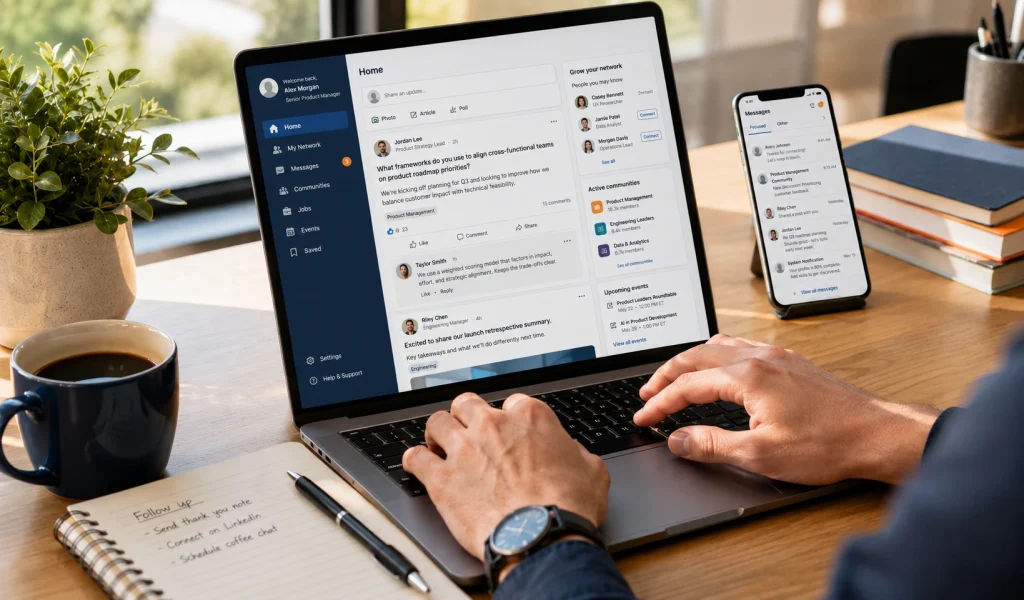
Not every professional has the time or budget for regular events, and digital platforms let networking happen in smaller, more frequent doses from a desk. Each platform has its own etiquette for turning visibility into an actual relationship, covered strategy by strategy below.
6. Engage actively on LinkedIn
LinkedIn networking works through visible participation, not passive connection requests. Commenting substantively on posts in your industry, adding a data point, a counterpoint, or a specific experience, puts you in front of people who’d never accept a cold connection request.
Post your own take on industry developments once a week; consistency here matters more than virality. When you do reach out directly, reference something specific from their content or work. Generic “I’d like to connect” requests get ignored or forgotten within a day.
The instinct to lean on real people is well-founded: 43% of professionals name their network as their first stop for advice at work, ahead of both AI tools and search engines.
7. Participate in niche Facebook groups
Industry-specific and local business Facebook groups tend to have less noise and more genuine peer conversation than people expect from the platform. Look for groups tied to your profession, your city’s business community, or a specific niche (e.g., “freelance copywriters,” “SaaS founders under $1M ARR”).
Answer questions before asking any; group members remember who was actually helpful. Because these groups are smaller and less public than LinkedIn, conversations tend to be more candid, which builds trust faster.
8. Engage in Twitter/X industry communities
Twitter/X networking happens in the replies, not the main feed. Following and engaging with 20 to 30 specific people in your niche, consistently, builds more real relationships than posting into the void.
Threads and public conversations create low-pressure entry points to connect with people you’d have no natural reason to email cold. It’s also where a lot of informal industry news breaks first, giving you natural, timely conversation starters. DMs work best after some public back-and-forth has already established familiarity.
9. Join Slack & Discord communities
Paid and free professional Slack/Discord communities have largely replaced old-school forums for real-time industry conversation. These skew toward more candid, in-the-weeds discussion than LinkedIn, since they’re smaller and less publicly visible.
Look for communities tied to your specific tools, role, or niche rather than broad “entrepreneur” communities, which tend to be shallower. Show up in threads consistently over weeks before DMing anyone directly; in these spaces, lurking then posting once reads as networking for its own sake, and people notice.
10. Answer questions on industry-specific subreddits
Reddit rewards genuinely useful answers, not self-promotion. The networking value comes from becoming a recognized, helpful voice in a niche subreddit over time, not from any single post.
Answer questions in your area of expertise without self-promotion; let people find your profile if the answer is good enough. This is a slower-build strategy than LinkedIn or events, but the trust it generates is unusually durable, and it’s one of the few channels where strangers reach out to you first.
Community and affiliation-based

Some of the strongest professional relationships come from a shared context rather than from direct networking at all. Associations, alumni ties, and peer groups give people a built-in reason to trust you before you’ve said a word about your business.
11. Join a professional or trade association
Trade and professional associations offer built-in credibility and structured access, including membership directories, annual conferences, and regional chapters, that ad hoc networking can’t replicate.
The relationships formed here tend to be longer-lasting because the shared professional identity provides an immediate starting point for conversations. Volunteer for a committee or local chapter role rather than just attending events; active members get disproportionately more visibility and access than passive ones.
12. Tap into your alumni network
Alumni networks have an unusually high response rate to cold outreach; a shared school is often enough context to warrant a reply that a stranger wouldn’t get.
Most universities maintain searchable alumni directories by industry, location, or company. Use them deliberately rather than waiting for reunion events. The relationship starts warmer than most networking contexts, but it still requires genuine follow-through. Treating alumni status as a favor-guaranteed shortcut rather than a conversation starter tends to backfire.
13. Join a mastermind or peer advisory group
Small, recurring peer groups (6 to 12 people, meeting monthly) build a different kind of network than events do: fewer people, but far deeper trust, since members share real business problems rather than surface-level updates.
These groups work best when composed of non-competing peers at a similar stage, so advice is candid rather than guarded. The commitment is greater than that of a one-off event, but the payoff compounds. Mastermind members often become each other’s first call for referrals, partnerships, and honest feedback.
14. Volunteer or serve on a nonprofit board
Volunteering and nonprofit board seats put you in a room with senior professionals and business owners you likely couldn’t access through cold outreach, in a context where everyone is motivated by something other than direct business gain.
Board service in particular tends to attract executives and founders who are otherwise hard to reach; the shared cause creates trust faster than a networking event would. Choose a cause you’re genuinely invested in. Networking-motivated volunteering that isn’t sincere is usually obvious and undermines the relationships it’s meant to build.
15. Work from a coworking space
Shared workspaces create ambient, low-effort networking simply through physical proximity, as kitchen conversations and community events surface connections that wouldn’t arise from deliberate outreach.
Many coworking spaces run their own member events and Slack channels specifically to encourage this. The strategy works best if you’re consistent about which location and days you work from, since recognition builds over repeated encounters rather than a single visit.
It’s a particularly strong fit for solo professionals and small teams who’d otherwise have no organic daily contact with other businesses.
Relationship-leverage strategies

These strategies don’t rely on a specific venue or platform. Instead, they work by borrowing trust that already exists, whether from a mutual contact, a complementary business, or a podcast host’s audience, to open doors that cold outreach can’t.
16. Ask for warm introductions through existing contacts
A warm introduction converts faster than almost any cold outreach, since asking an existing contact to connect you to someone in their network borrows their credibility for the first conversation.
Be specific about who you want to meet and why, so the person making the introduction doesn’t have to guess. “Someone in marketing” gets a worse result than “someone doing B2B demand gen at a Series A startup.” Always give your contact an easy opt-out and make the ask low-effort, like a forwarded email intro, not a scheduling favor.
17. Build strategic partnerships with complementary businesses
Partnering with businesses that serve the same customers without competing, like a wedding photographer and a venue, or an accountant and a business attorney, creates an ongoing referral relationship instead of a one-time introduction.
These work best when formalized even loosely: an agreed referral process, a shared resource list, or co-hosted content. The relationship compounds over time because both sides have an ongoing incentive to keep referring, unlike a single favor-based introduction that has to be re-earned each time.
18. Guest on industry podcasts & interviews
Appearing as a guest on industry podcasts builds relationships with the host, often a well-connected figure in your niche, and reaches an audience who already trust the recommendation.
Pitch podcasts with a specific, narrow angle rather than “I’d love to talk about my business”; hosts field dozens of generic pitches and respond to specificity. The relationship with the host frequently outlasts the episode itself, turning into future referrals, co-promotion, or introductions to their own network.
The audience is only growing: monthly podcast consumption reached a record 55% among Americans ages 12 and up in 2025.
Creating and executing a business networking strategy
Picking a few strategies from the list above is only half the work. Without a plan behind them, even the best-matched strategies become sporadic, disconnected activity rather than a system that compounds over time. Here’s how to turn a handful of strategies into an actual networking strategy.
1. Set a specific goal, not a general one
“Network more” isn’t a goal, because it gives you no way to measure whether it’s working. A specific goal does: “Build five referral relationships with complementary service providers this quarter” or “Get in front of 10 potential clients at industry events by Q3.” A specific goal also tells you which strategies from the list above are actually worth your time and which aren’t.
2. Choose 3 to 4 strategies, not all 18
Trying to run conferences, LinkedIn, a mastermind group, and podcast guesting all at once spreads effort too thin to build real depth in any of them.
Pick a small combination that fits your goal, your industry, and how you actually like to work; for example, a solo consultant might combine LinkedIn, one trade association, and warm introductions, while a sales team might combine trade shows, a referral group, and strategic partnerships.
Depth in a few channels beats a shallow presence in all of them.
3. Build a simple system to track your network
A spreadsheet, a CRM, or even structured notes are all fine, as long as it lets you see who you know, what they do, when you last talked, and what you owe them. Without a system, your network is only as good as your memory, which starts to break down past 20 to 30 relationships. Log a note right after every meaningful conversation while it’s still fresh, not days later.
4. Keep your digital business card ready
Every strategy above eventually creates the same moment: someone wants to save your info and follow up. Have your digital business card ready to share by tapping, scanning, or linking at conferences, meetups, panels, or even during a warm introduction over coffee. It removes the single biggest point of friction in networking: the gap between “let’s stay in touch” and someone actually saving your contact, which is where most follow-ups quietly die.
5. Follow up within 48 hours, every time
The gap between people who network well and people who don’t usually isn’t the initial conversation; it’s the follow-up. A short, specific message within a day or two of meeting someone, referencing something you actually talked about, converts far more often than a generic “great to meet you” sent a week later or not sent at all.
6. Set a review cadence
Every quarter, look back at what’s actually working: which strategies led to real conversations, which conversations turned into referrals or business, and which channels are eating time without a return. Drop what isn’t working and double down on what is. A networking strategy that never gets reviewed just repeats whatever you happened to try first, whether or not it’s paying off.
Bringing it all together
There’s no single “right” way to network. The difference between professionals who network well and those who don’t usually isn’t access to better opportunities; it’s whether they’ve chosen their strategies on purpose and followed through consistently.
Pick three or four strategies from the 18 above that fit your goals, give them a real quarter, and build the habit of tracking and following up that makes any of them pay off.
Whichever you choose, most of it comes down to one moment: someone wants to save your contact and follow up. DigitalBusinessCard.Pro makes that moment easy, whether you’re at a trade show, wrapping up a panel, or handing off a warm introduction, with one shareable card that saves straight into a contact list and stays current.
Frequently asked questions
What is the best business networking strategy for someone just starting out?
Start with two or three strategies that fit your industry and personality rather than trying all of them at once. A mix of one in-person option (like a local meetup or trade association) and one digital option (like LinkedIn) works well, paired with a habit of following up within 48 hours of meeting someone.
How many networking strategies should a professional use at once?
Three to four is usually the right range. Spreading effort across too many channels, events, LinkedIn, Slack communities, associations, and more tends to produce a shallow presence everywhere rather than real depth anywhere.
What’s the difference between networking online and in person?
In-person strategies (conferences, meetups, hosting events) build trust faster through shared physical presence, while digital strategies (LinkedIn, niche communities, Reddit) let you build relationships in smaller, more frequent doses without needing to travel or attend on a schedule. Most effective networkers combine both.
How do I network if I don’t have time to attend events?
Digital and community-based strategies, LinkedIn engagement, niche Facebook or Slack groups, and warm introductions through existing contacts require less scheduled time than events and can be done in short, consistent sessions rather than blocks of travel time.
What’s the most common mistake professionals make when networking?
Treating a single conversation or event as the finish line. The strategies themselves rarely fail; what fails is the follow-up: without a system to track contacts and reach out within a day or two, even a great conversation goes nowhere.
How do I know which networking strategy is working?
Set a specific goal before you start (like “build five referral relationships this quarter”), then review quarterly which strategies actually produced real conversations or business, not just attendance or connection counts.
Do referrals and warm introductions really work better than cold outreach?
Yes, warm introductions borrow the credibility of the person making the connection, which is why they tend to convert faster than cold approaches; the same logic is why referral-based hiring and referral groups consistently outperform unstructured outreach.
You may also like
Professional Email Signature Guide: What to Include and How to Create One
This guide discusses what a professional email signature is, what to include in it, how to create one, and how to use it with your digital card.
5 Best Event Lead Capture Tools in 2026
Event lead capture gets messy fast. Let’s look at the five best event lead capture tools, and how to choose the right one.
How Much Does a Digital Business Card Cost? (2026 Pricing Guide)
This guide helps you understand how much a digital business card costs and how much to invest based on your requirements.
How to Integrate Digital Business Card with Your HubSpot
Learn how to connect HubSpot with Digital Business Card PRO, map form fields, and automatically send digital business card form submissions to HubSpot.