A rep drives forty minutes to a meeting, pulls up the wrong deck on their phone, and hands the prospect a business card that doesn’t match the one their teammate left at the last stop.
None of that is a training problem. It is a sales enablement problem, and it is the exact gap that most enablement programs, built for reps who sit at a desk, never account for.
Sales enablement for field teams is the set of content, tools, training, and processes that equip reps who sell in person, on the road, and outside a traditional office to sell consistently and close more effectively. It covers everything from what a rep says in a meeting to how they capture a lead five minutes later in a parking lot.
This guide breaks down what it actually involves, how to build a strategy around it, and how to measure its effectiveness.
Key Takeaways:
- Field reps need enablement built for offline, on-the-go conditions.
- Desk-designed content and tools break down in the field fast.
- Consistent brand identity across reps builds trust at scale.
- Closing the field-to-CRM gap is the biggest lever for visibility.
- Measure quota, win rate, and CRM lag, not just content volume.
- What is sales enablement?
- Why field teams break standard sales enablement
- What are the elements of a sales enablement strategy for field teams?
- How to build a sales enablement strategy for field teams: step by step
- Common mistakes in field sales enablement
- How to measure sales enablement success
- Where digital business cards fit in
- How DigitalBusinessCard.Pro helps with sales enablement for field teams
- Getting started with sales enablement for field teams
- Frequently asked questions
What is sales enablement?

Sales enablement is the practice of giving sales teams the content, training, tools, and data they need to engage buyers effectively and close deals faster. It sits at the intersection of sales, marketing, and operations, and its job is to ensure the right resource (a pitch deck, a competitive battlecard, a pricing sheet, or a piece of onboarding training) reaches the right rep at the right moment.
Sales enablement is no longer a nice-to-have function. 55% of C-suite leaders now treat sales enablement technology as a priority investment, and 87% of Cloud 100 companies report having dedicated enablement professionals on staff. Organizations with a formal enablement program report a 49% win rate on forecasted deals, compared to 42.5% for organizations without one.
For field teams specifically, sales enablement takes on an extra layer: content has to be accessible offline or on a phone, training has to be short enough to consume between appointments, and the tools reps use to capture a lead or share their contact details have to function the moment a conversation ends, not after the rep gets back to the office.
Why field teams break standard sales enablement
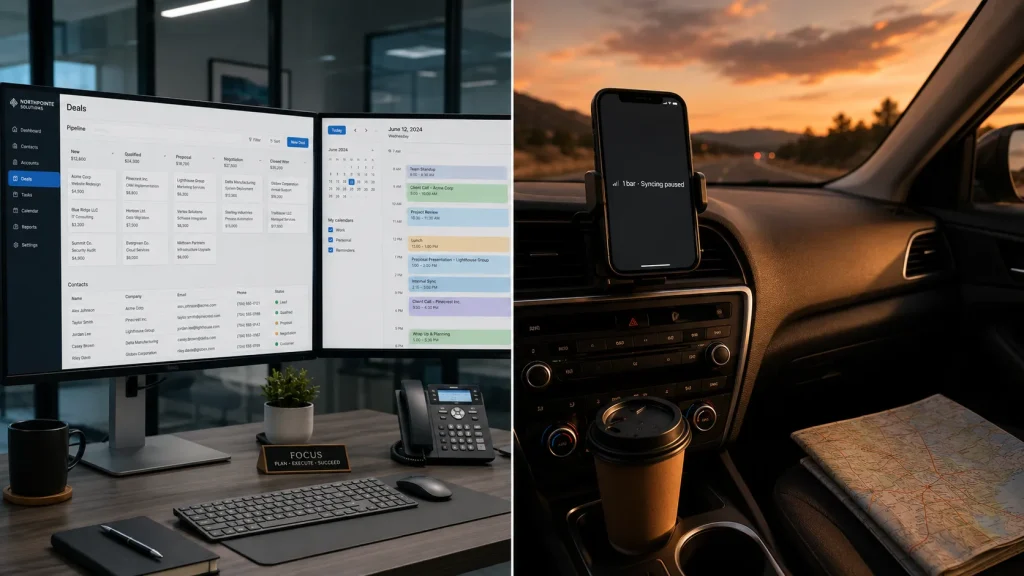
Most sales enablement programs are designed around a rep sitting at a desk with two monitors, a stable connection, and a CRM tab always open. Field teams operate under none of those conditions. They move between locations, lose signal, switch between a car and a client’s lobby, and often go a full day without touching a laptop.
That mismatch shows up in the numbers. In Gartner’s Seller Skills Survey of 1,026 B2B sellers, fielded in early 2024, 70% of sellers reported feeling overwhelmed by the number of technologies required to do their jobs, most of which are built for desk-based workflows.
And the administrative drag is real across sales in general: sales professionals report spending as little as 28% of their time on actual selling, depending on the survey, with the rest lost to data entry, content searches, and internal admin.
Field teams feel this more acutely because their “desk” is a truck, a sidewalk, or a client’s waiting room. Reps using a properly built mobile system spend more time selling and less time updating systems, precisely because the friction of standard tools disappears when data capture happens automatically instead of through manual entry after the fact.
The result, when enablement ignores this reality, is a rep who has the right training but the wrong tools for where they actually work. That gap is what a field-specific sales enablement strategy is meant to close.
What are the elements of a sales enablement strategy for field teams?
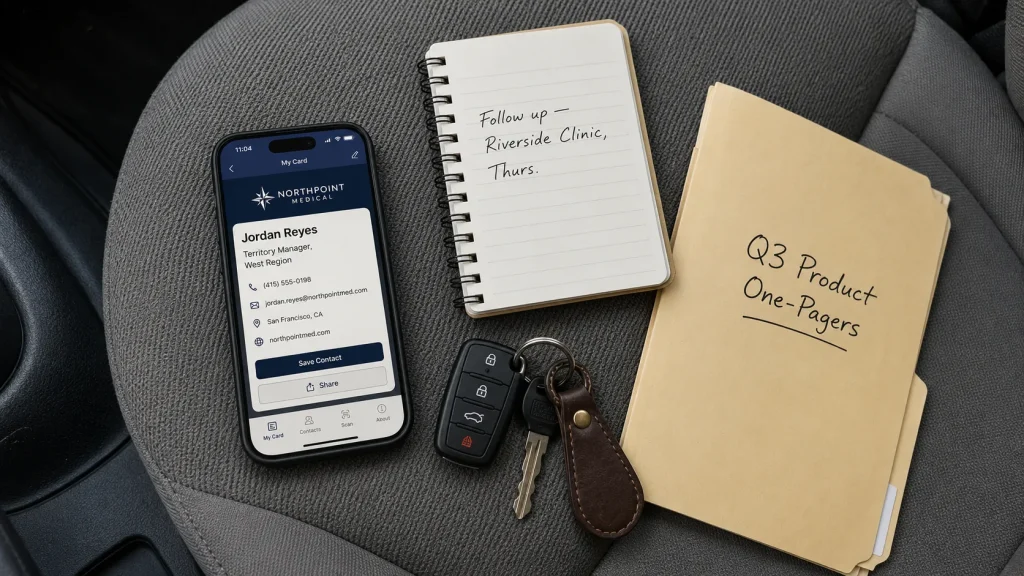
A sales enablement strategy for field teams generally rests on five connected elements. Weakness in any one of them tends to undercut the others, since field reps have less time and fewer opportunities to compensate for gaps than desk-based sellers do.
| Element | What It Covers | Why It Matters for Field Teams |
|---|---|---|
| Content & Collateral | Pitch decks, one-pagers, case studies, battlecards | Needs to work offline and load fast on a phone between visits |
| Training & Coaching | Onboarding, product updates, role-play, in-field coaching | Must be delivered in short segments reps can absorb on the road |
| Tools & Technology | Digital business card, mobile CRM, contact and lead capture, e-signature | Has to function with poor signal and require minimal manual entry |
| Process & Playbooks | Standardized meeting flows, follow-up cadences, escalation paths | Keeps every rep representing the brand the same way, regardless of territory |
| Data & Measurement | Pipeline visibility, activity tracking, content usage analytics | Gives managers insight into reps they rarely see in person |
A useful gut check for any of the five: would this still work for a rep standing outside a client’s building with one bar of signal and eight minutes before their next appointment? If the answer is no, it isn’t field-ready yet.
How to build a sales enablement strategy for field teams: step by step
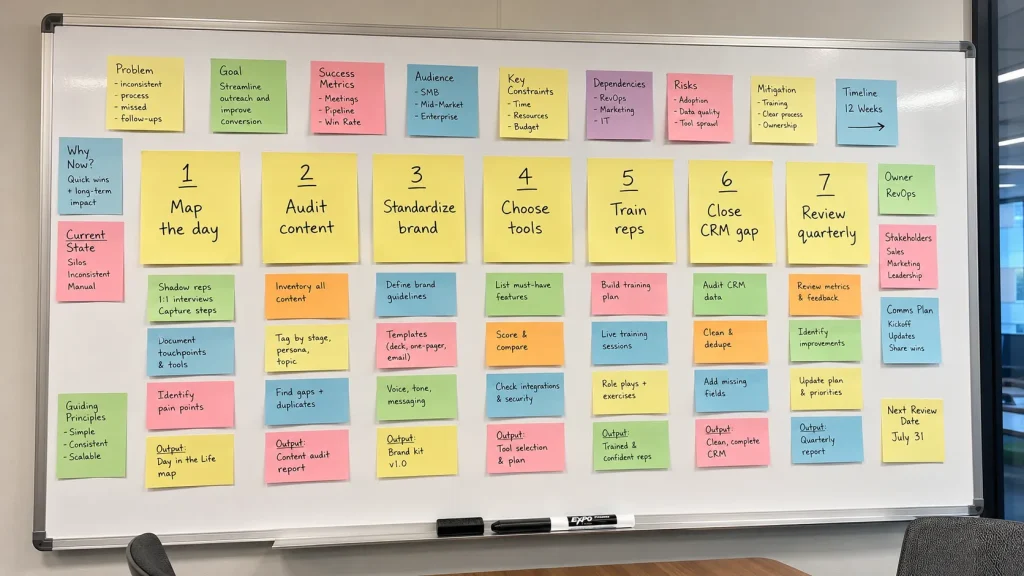
Building the strategy is less about picking tools first and more about understanding how reps actually spend their day, then designing content, training, and technology around that reality. The steps below follow that order.
1. Map the actual field day, not the assumed one
Before choosing tools or writing training, shadow a handful of reps for a real day. Note where they lose signal, how long they spend between appointments, and what they do in the five minutes after a meeting ends. The average outside sales rep completes 5.1 visits per day, while the top 10% complete nearly 14. That gap is rarely about effort alone; it is often about how much friction sits between visits.
2. Audit existing content for field usability
Pull every asset reps are expected to use and ask whether it works on a phone, offline, in under two minutes. Sales reps spend 60% of their time on non-selling tasks, including hours lost hunting for the right pitch deck or case study, largely because that content was built for a desk-based workflow that field reps never experience.
3. Standardize the moments that touch the brand
Every field rep is, in effect, a walk-in storefront for the company. What they hand a prospect, how they introduce the product, and how they follow up should look and feel the same whether the rep is in Denver or Dallas. Inconsistency here is one of the fastest ways a growing field team starts to look unprofessional at scale.
4. Choose tools that remove steps, not add them
The rule of thumb for field tools is simple: if a rep has to stop walking to finish an action, the tool has too much friction. Digital business cards and mobile-first CRMs are seeing strong adoption, largely because well-designed tools capture data automatically (GPS check-ins, synced calendars, voice notes) rather than asking reps to type it in later.
5. Build training around real objections and real terrain
Generic sales training rarely accounts for field-specific realities, like walking into a cold storefront or handling a gatekeeper in person rather than over email. Coaching should be built from actual field call notes and delivered in formats reps can consume in five-minute windows.
6. Close the loop between the field and the CRM
The single biggest point of data loss in field sales is the gap between “the meeting happened” and “the CRM was updated.” Every hour that gap stays open is an hour a manager is flying blind.
Tools that capture a lead or a new contact at the moment of the interaction, rather than relying on a rep’s memory later that evening, close this gap directly.
DigitalBusinessCard.Pro fills that gap. Capture leads via lead-capture forms on your digital business card and automatically sync them to your CRM on paid plans. More on this in the sections below.
7. Review and refresh quarterly
Field enablement decays fast because territories, products, and competitive landscapes shift constantly. A quarterly review of which content gets used, which training gets skipped, and which tools reps quietly stop using is the difference between a strategy that stays relevant and one that slowly becomes shelfware.
Common mistakes in field sales enablement
Most of these mistakes come from the same root cause: building enablement for the conditions reps are assumed to work in, rather than the conditions they actually work in.
- Designing for the desk, deploying to the field: Content and training built by a marketing or enablement team sitting at headquarters often assumes conditions (steady wifi, a second monitor, uninterrupted time) that field reps rarely have.
- Measuring activity instead of outcomes: Tracking how many pieces of content exist or how many training modules were completed says little about whether reps are actually winning more deals in the field.
- Ignoring offline reality: A tool or deck that fails the moment a rep loses signal gets abandoned within days, no matter how good it looks in a demo.
- Treating enablement as a one-time launch: Most organizations never revisit their enablement program after launch, so it is treated as a project rather than a continuous discipline.
- Letting brand identity drift across reps: Without a shared, easy-to-use standard for how reps present themselves and their contact information, a growing field team starts to look like a collection of freelancers rather than one company.
- Overloading reps with tools rather than removing friction: The majority of B2B sellers already feel overwhelmed by their sales tools. Adding another disconnected app rarely solves the problem; consolidating steps does.
How to measure sales enablement success
Measuring field sales enablement means tracking a mix of adoption, efficiency, and revenue metrics, since a program can look successful on paper while quietly failing in the field.
| Metric | What It Tells You | Benchmark to Watch |
|---|---|---|
| Quota attainment | Whether training and tools translate into actual quota performance | Organizations with strong enablement report roughly 84% quota achievement among reps |
| Win rate | Whether enabled reps close a higher share of forecasted deals | Enabled organizations report close to 49% win rates versus roughly 42.5% without a program |
| Onboarding time | How quickly new field reps become productive | Strong enablement programs cut onboarding time by 40% to 50% |
| Content usage | Whether reps are actually using the assets built for them | Up to 65% of content goes unused in organizations without a field-specific content strategy |
| Time to CRM update | The gap between an interaction happening and it being logged | Should approach real-time with automated capture tools |
| Pipeline conversion rate | Whether more field activity is translating into pipeline | Top-performing enablement programs report roughly 25% increases in pipeline conversion |
The metric that matters most for field teams specifically is the gap between field activity and system visibility. A manager who cannot see what happened in the field until a rep manually logs it that evening is managing on a delay, and every metric above becomes less reliable the longer that delay stretches.
Where digital business cards fit in
Sales enablement for field teams ultimately comes down to removing friction in the moments reps spend representing the company outside the office, and one of the most frequent friction points is the simplest: how a rep shares who they are and records who they just met.
Paper business cards get lost, spreadsheets of names collected at events sit untouched until someone finally transcribes them, and generic CRM contact fields require a rep to stop and manually type information after a conversation already ended. Each of these is a small tax on a rep’s time, and across a field team of any size, that tax adds up to lost leads and inconsistent brand presentation.
This is where digital business cards fit into the broader enablement stack, specifically for the identity and contact-capture layer, not as a replacement for CRM, training, or content strategy.
| Paper Cards / Spreadsheets | Generic CRM Contact Entry | DigitalBusinessCard Pro | |
|---|---|---|---|
| Setup per rep | Reprint every time details change | Manual, after the fact | One shared, brand-locked template |
| Brand consistency across reps | Depends on print runs and who ordered what | Not applicable | Centrally managed and locked |
| Lead capture at the moment of contact | None, relies on the other person keeping the card | None, requires manual entry later | Built into the card on paid plans |
| Update after a rep changes role or territory | Reprint required | Manual field update | Updates instantly for every card holder |
For a field team, the value isn’t the card itself. It’s that every rep presents the same brand-approved identity, and every lead captured in the field flows into the pipeline without waiting for a rep to sit down and type it in later. Individual reps testing this ahead of a full team rollout can start with a single free card before rolling it out across the territory.
How DigitalBusinessCard.Pro helps with sales enablement for field teams
For a distributed field team, DigitalBusinessCard.Pro handles one specific piece of the enablement stack: giving every rep a consistent, brand-locked identity and a built-in way to capture leads the moment a conversation happens, without adding another app for the person on the other side.
- Brand-locked templates: Every rep’s card follows the same approved layout, so a prospect meeting three different reps across three regions sees one consistent brand, not three interpretations of it.
- Lead capture built into the card: A rep doesn’t need to remember to log a contact later. The card itself can collect the other person’s details at the point of contact, so the lead lands in the pipeline rather than in a jacket pocket or a notes app.
- Centralized updates: When a rep changes their title, territory, or contact details, the card is updated everywhere it’s already been shared. No reprint and no re-send required.
- Per-rep visibility: Managers can see which cards are being shared and scanned, giving a read on field activity that doesn’t depend on a rep remembering to update the CRM that evening.
- No app required for the recipient: A prospect can view and save a rep’s card without installing anything, which matters in field settings where a smooth handoff at the end of a conversation is often the difference between a captured lead and a lost one.
DigitalBusinessCard.Pro is built to close. For a field team, that makes it less of a nice-to-have add-on and more of the connective layer that determines whether everything else you’ve invested in enablement actually shows up as pipeline.
Getting started with sales enablement for field teams
Field teams don’t fail at sales because reps lack effort or skill. They fail when the content, training, and tools built for a desk-based workflow get handed to people who never sit at one.
The programs that actually move the numbers (higher quota attainment, faster ramp time, more pipeline from field activity) are the ones built around how reps actually work: offline, on the move, and often five minutes away from the next conversation.
Start small. Map a real field day, audit what content and tools reps actually use versus what they were handed, and close the biggest gap first, usually the one between a field interaction happening and it showing up anywhere a manager can see it.
From there, the rest of the strategy builds on a foundation that already reflects reality rather than fighting it.
On top of it, DigitalBusinessCard.Pro closes the one gap the rest of that strategy can’t fix on its own: ensuring a field conversation turns into a captured lead rather than a lost one. One card, updated instantly, synced the moment it’s needed.
Frequently asked questions
What is sales enablement for field teams?
It is the combination of content, training, tools, and process built specifically for reps who sell outside a traditional office, accounting for limited connectivity, time between appointments, and the need for brand consistency across a distributed team.
What is the difference between sales enablement and sales training?
Sales training is one component of sales enablement. Enablement is the broader discipline that also includes content, tools, processes, and ongoing measurement, while training is specifically about building reps’ skills and product knowledge.
What tools do field sales teams need most?
At minimum, a mobile-first CRM built for offline use, route and territory planning, and a fast way to exchange contact details and capture leads at the moment of interaction. DigitalBusinessCard.Pro covers this directly, with built-in lead capture, contact exchange, and CRM routing on one card.
How do you measure sales enablement success for a field team?
Track a mix of quota attainment, win rate, onboarding time, content usage, and the time gap between a field interaction and when it appears in the CRM. The last one is the clearest early signal of whether field-specific friction has actually been removed.
How is field sales enablement different from enablement for inside sales?
Inside sales enablement assumes a stable desk setup and constant system access. Field enablement has to work offline, be consumable in short bursts between appointments, and account for reps representing the brand in person rather than over a screen.
You may also like
Professional Email Signature Guide: What to Include and How to Create One
This guide discusses what a professional email signature is, what to include in it, how to create one, and how to use it with your digital card.
5 Best Event Lead Capture Tools in 2026
Event lead capture gets messy fast. Let’s look at the five best event lead capture tools, and how to choose the right one.
6 Best Digital Business Card Platforms for Teams in 2026
Compare the 6 best digital business card platforms for teams and find the right platform for your organization.
How Much Does a Digital Business Card Cost? (2026 Pricing Guide)
This guide helps you understand how much a digital business card costs and how much to invest based on your requirements.